

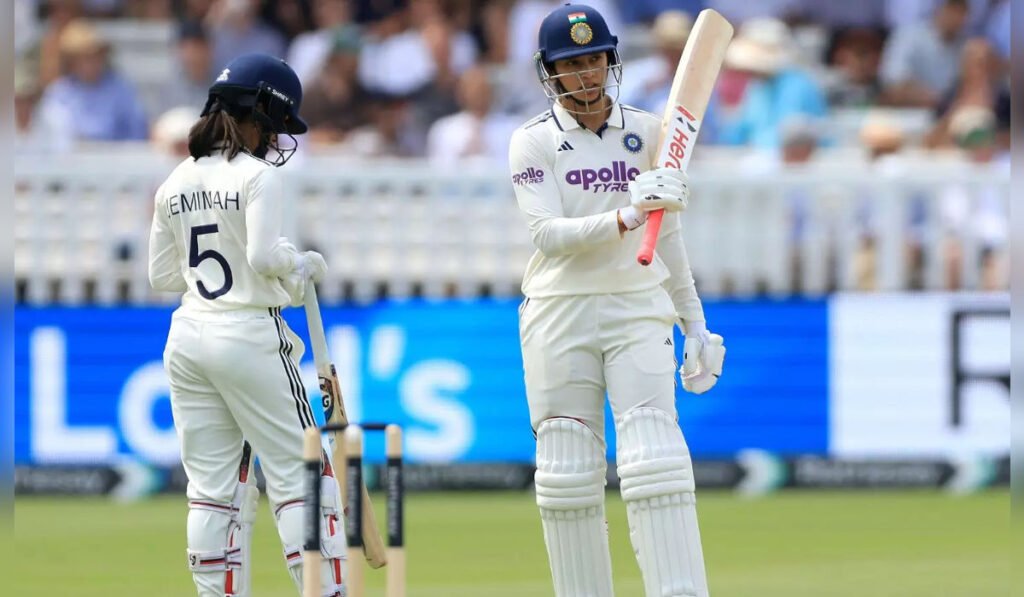
At the first Women’s Test ever staged at Lord’s, Smriti Mandhana marked her 300th international appearance with a commanding 83 as India’s collective batting strength and disciplined bowling signalled the emergence of a confident new Test identity.
By Anjana Sasi
London: There are cricket matches that shape a series, and there are those that become part of the sport’s permanent history. The ongoing one-off Test between India and England at Lord’s firmly belongs in the second category.
For the first time in nearly 150 years of cricket, Lord’s hosted a Women’s Test at the Home of Cricket. It was far more than another fixture on the international calendar. It was the correction of history—a moment generations of women cricketers had waited for and one that finally placed women’s Test cricket on one of the game’s grandest stages.
India arrived not merely to participate in the occasion but to shape it.
After posting a competitive 285 in their first innings through significant contributions from Smriti Mandhana (83), Harmanpreet Kaur (58) and Deepti Sharma (57), the visitors carried that momentum into the second day. Having claimed an England wicket late on the opening evening, India resumed with renewed intensity, reducing the hosts to four wickets down and tightening their grip on the contest through disciplined, relentless bowling.

More Than a Milestone for Mandhana
Some milestones become even more special because of the stage on which they are achieved.
Smriti Mandhana’s 300th international appearance could hardly have come at a more fitting venue. Already one of the modern greats of women’s cricket, she became the youngest woman in history to reach the landmark of 300 international matches.
Achieving the feat at Lord’s, during the venue’s inaugural Women’s Test, elevated the occasion beyond personal achievement into cricketing history.
Her innings of 83 perfectly reflected the qualities that have defined her career.
Rather than allowing emotion to dictate her approach, Mandhana trusted her technique during the challenging opening spell before gradually taking control through elegant strokeplay. Her fluent cover drives, disciplined judgement outside the off stump and willingness to leave deliveries carrying risk illustrated a batter who understands that Test cricket rewards patience as much as brilliance.
She narrowly missed a century, but the innings had already achieved something equally valuable. It stabilised India’s innings after early setbacks and laid the foundation for a competitive first-innings total.

India’s Batting Has Developed a New Identity
Perhaps the most encouraging aspect of India’s performance was not the final score but the manner in which it was constructed.
There was a time when India’s overseas batting fortunes depended heavily on one or two players producing extraordinary innings.
This team looks different.
Mandhana absorbed the pressure of the new ball. Harmanpreet Kaur brought authority and composure through the middle overs. Deepti Sharma once again demonstrated why she remains among the world’s premier all-rounders, guiding the lower order with intelligence after England threatened to seize control.
Three players.
Three different batting styles.
One common objective.
Collective responsibility.
That may ultimately become the defining characteristic of this Indian side.
England Fight Back, But India Stay Ahead
England deserve considerable credit for preventing India from posting a truly imposing total.
Having reduced India from a commanding position to 285 all out, the hosts ensured the visitors left valuable runs on the field. Their disciplined seam bowling after tea, complemented by intelligent use of spin, demonstrated why England remain among the strongest Test sides in women’s cricket.
Yet there is an important distinction between restricting an opponent and controlling a match.
India still dictated the larger narrative.
On a Lord’s surface offering encouragement to both batters and bowlers, a first-innings total of 285 was always likely to prove highly competitive.
Scoreboard Pressure Begins to Tell
The opening exchanges of England’s innings highlighted one of Test cricket’s oldest truths.
Pressure rarely disappears.
It simply changes hands.
India’s bowlers attacked with patience and precision, refusing to offer easy scoring opportunities. Rather than searching for miracle deliveries, they consistently challenged England’s batters with disciplined lines and lengths.
That persistence quickly yielded rewards.
India’s first-innings total became a source of psychological pressure, forcing England’s batters to prioritise survival rather than domination.
Young fast bowler Kranti Gaur epitomised that approach, striking three crucial blows to place England firmly on the back foot.
It is exactly the blueprint successful Test teams follow.
Build a competitive total.
Create scoreboard pressure.
Allow the bowlers to exploit uncertainty.
India have executed each phase with growing confidence.
A Team Beginning to Believe
Perhaps the biggest transformation within this Indian side is psychological.
This is no longer a team waiting for moments of individual brilliance.
There is greater tactical discipline.
Partnerships are becoming longer.
Bowling plans are clearer.
Field placements reflect patience rather than desperation.
Most importantly, India are beginning to play Test cricket with the confidence of a side that genuinely believes it belongs among the world’s elite red-ball teams.
That belief may ultimately prove more significant than any individual performance.
History Still Has More Chapters to Write
Regardless of the final result, this Test has already secured its place in cricket history.
Lord’s has finally hosted a Women’s Test.
Smriti Mandhana celebrated her 300th international appearance by becoming the youngest woman to reach that remarkable milestone.
India have responded to the occasion not with nervousness, but with authority.
With England already four wickets down, the visitors have positioned themselves to transform a historic occasion into one of their most memorable overseas Test victories.
Cricket’s greatest venues demand performances worthy of their reputation.
Across the opening two days, India have shown they are not merely participating in history.
They are helping to redefine it.


