

THE ULHAS CORRIDOR SERIES | PART II OF III
As the proposed Water Metro gains attention across eastern MMR, the bigger debate has now shifted from vision to viability — can the Ulhas River realistically support a large-scale urban transit system?
By Vivek Bhavsar | Editor-in-Chief, TheNews21
In rapidly growing metropolitan regions, almost every major infrastructure idea initially sounds unrealistic. Metro rail systems once appeared financially impossible for Indian cities. The Mumbai Trans Harbour Link was long dismissed as an over-ambitious engineering dream. Even the Mumbai–Nagpur Samruddhi Mahamarg faced skepticism during its conceptual phase. The proposed Kalyan–Badlapur Water Metro now enters a similar zone of public debate — suspended somewhere between visionary urban planning and hard engineering reality.
In Part I of this series, TheNews21 examined how the eastern Mumbai Metropolitan Region is entering a major infrastructure transition driven by highways, logistics corridors, industrial growth and expanding urbanisation. The Water Metro proposal submitted by former Kulgaon-Badlapur Municipal Council President Nandkishor alias Ram Patkar was analysed within that broader regional context.
But once the initial excitement around the idea settles, the real policy questions begin. Can the Ulhas River actually sustain year-round passenger-grade navigation? Will the economics of the project remain viable after large-scale dredging and river engineering costs emerge? Could environmental clearances delay or fundamentally alter the project? And perhaps most importantly — are urban waterways genuinely capable of becoming mainstream transport systems in Indian metropolitan regions outside limited pilot models?
These are not political questions. They are engineering, environmental and financial questions and they will ultimately decide whether the proposal remains a concept document — or evolves into a serious infrastructure project.
The DPR submitted to the Maharashtra government proposes a 32–38 km electric water transit corridor connecting Kalyan, Shahad, Ulhasnagar, Ambernath, Vhaloli and Badlapur through six terminals and a fleet of electric catamaran vessels. The project estimates range between ₹1,290 crore and ₹2,900 crore, with a mid-range estimate of around ₹2,030 crore. At first glance, the proposal appears attractive precisely because it avoids one of India’s largest infrastructure obstacles — land acquisition.
Unlike metro rail corridors or large highway expansions, waterways theoretically utilise an already existing natural corridor. In densely urbanising regions where acquiring land has become economically expensive and politically sensitive, this is a significant advantage. The proposal also aligns with broader global conversations around green mobility. The DPR promises a fully electric fleet with zero direct emissions, reduced carbon footprint and integration with sustainable riverfront development.
For policymakers increasingly under pressure to present environmentally sustainable infrastructure models, such positioning carries obvious appeal. Yet beneath the attractive language of “green transport” lies an extremely difficult technical challenge. Unlike controlled metro corridors or engineered highways, rivers are dynamic systems. The Ulhas River is not a pristine Scandinavian waterway. Across multiple stretches, it suffers from sewage inflows, industrial discharge, encroachments, silt accumulation and fluctuating water behaviour during monsoons. Large sections would require continuous dredging and maintenance to sustain navigable depth for passenger vessels.
The DPR itself acknowledges that maintaining a 2.5 to 3.5 metre depth across the proposed corridor would require extensive dredging operations and dredging is where infrastructure economics often become unpredictable.
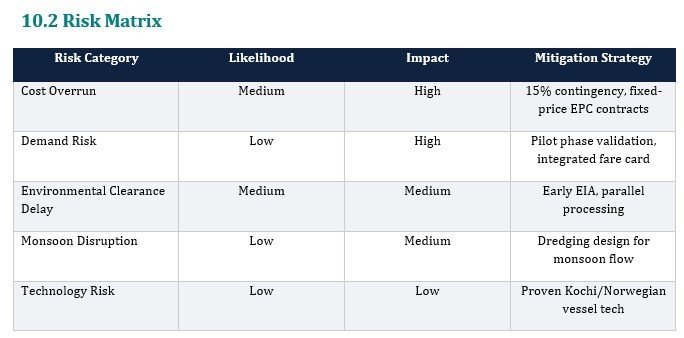
Globally, river dredging projects are notorious for cost escalation because riverbeds continuously change due to sediment movement, monsoon flow and erosion patterns. Maintaining navigability is not a one-time engineering intervention — it becomes a recurring operational commitment. This is one reason why the DPR’s own cost estimates display substantial variation. River works alone are estimated between ₹500 crore and ₹1,200 crore depending on engineering requirements. That uncertainty is significant.
Environmental clearances could emerge as another major obstacle. The project would likely require approvals involving the Ministry of Environment, Forest and Climate Change (MoEFCC), Maharashtra Pollution Control Board, Water Resources Department and maritime authorities. Any large-scale dredging within ecologically sensitive river systems typically invites scrutiny regarding: biodiversity impact, riverbank alteration, floodplain dynamics, fisheries, mangroves, and water quality implications.
Ironically, the project’s strongest environmental argument could also become one of its most debated claims. The DPR argues that systematic dredging could improve the Ulhas River’s water-carrying capacity and potentially help reduce flooding in surrounding regions. That may indeed hold partial technical validity in certain stretches. But hydrological systems are rarely that straightforward. River engineering intended for navigation can sometimes produce unintended ecological or flood-management consequences elsewhere in the basin. Any serious feasibility assessment would therefore require sophisticated hydrological modelling rather than broad assumptions.
Ridership projections present another important question. The DPR estimates potential daily ridership of up to 60,000 passengers. But transportation behaviour is shaped not merely by infrastructure availability — it is shaped by commuter psychology, affordability, frequency, integration and reliability. Mumbai’s suburban rail network, despite overcrowding, functions with extraordinary frequency and deeply embedded commuter habits. Convincing large commuter populations to shift meaningfully toward water-based transit may prove far more difficult than ridership models suggest.
Even Kochi’s success cannot automatically be replicated. Kochi’s urban geography is naturally interconnected through waterways and islands. The Kalyan–Badlapur corridor is fundamentally structured around rail-centric suburban movement patterns. That distinction matters. The governance architecture of the proposed project also remains unclear. Would the Water Metro operate under MMRDA? Maharashtra Maritime Board? A Special Purpose Vehicle? A PPP concessionaire? Or a hybrid model involving multiple agencies?
India’s infrastructure history repeatedly demonstrates that institutional fragmentation can delay even technically viable projects for years. Ram Patkar, however, argues that unconventional infrastructure thinking has become necessary because conventional transport systems are approaching saturation. “Every major infrastructure idea appears difficult in the beginning. But eastern MMR is growing faster than traditional transport expansion can keep pace with,” Patkar told TheNews21 while discussing the proposal. That argument deserves serious consideration.
The eastern MMR belt is unquestionably entering a period of structural transformation. Logistics activity, warehousing, industrial growth and real-estate expansion are steadily altering the economic geography of the region. Transportation pressure will inevitably intensify over the next decade. The larger question is therefore not whether the region needs additional mobility infrastructure. It unquestionably does. The real question is whether waterways can realistically become part of that future infrastructure mix — or whether the idea ultimately remains more visionary than viable.
At this stage, the Kalyan–Badlapur Water Metro proposal occupies an unusual policy space. It is too ambitious to be dismissed casually as a symbolic political demand. But it is also far too complex to be accepted merely through visionary enthusiasm. Which is why the next phase becomes crucial.
Not political speeches. Not promotional presentations. But rigorous feasibility studies, hydrological assessment, environmental scrutiny and independent financial analysis. Because in infrastructure planning, imagination may start the conversation. But engineering reality always delivers the final verdict.
Coming Next in Part III
“Could Waterways Become Maharashtra’s Next Infrastructure Frontier After Roads, Metros and Expressways?”
The concluding part of The Ulhas Corridor Series will examine whether Maharashtra may eventually be forced to rethink rivers, creeks and waterways as strategic mobility and economic assets in an era of exploding urbanisation and rising infrastructure costs.


