By Vijay Shravan Gaikwad | Senior Agriculture Journalist & Policy Analyst
Mumbai: India is no longer hungry. But it is becoming unhealthy.
For decades, policy focus has been clear — produce more food, distribute more grain, ensure no one sleeps hungry. The Green Revolution, the Public Distribution System (PDS), and the scale of mid-day meal programmes have achieved that objective.
But a new reality is emerging — one that is less visible, but far more dangerous.
India may be calorie sufficient. But it is not nutritionally secure.
A 2026 white paper by the Protein Foods and Nutrition Development Association of India (PFNDAI), in collaboration with ITC and the Institute for Global Development, highlights the scale of this gap. The average Indian today consumes barely 42 grams of whole grains daily. The Indian Council of Medical Research recommends at least 125 grams.
That 83-gram gap is not just a statistic. It is the difference between metabolic health and a steady rise in lifestyle diseases — diabetes, heart conditions, obesity and hypertension.
India is not facing a food shortage. It is facing a nutrition imbalance.
From Staple to Disappearance
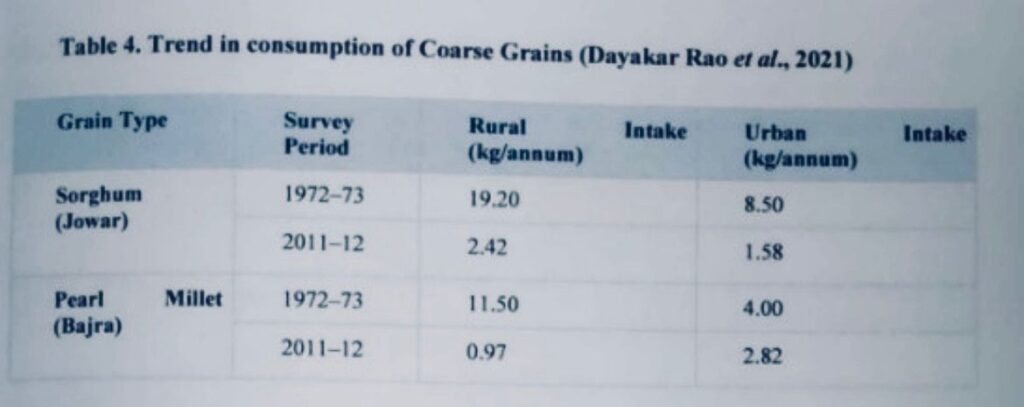
For centuries, India’s diet was built on diversity. Ragi in the south, bajra in the west, jowar in Maharashtra — these were not alternatives, but staples. They were embedded in local agriculture, climate patterns and cultural practices.
That diversity has steadily collapsed.
The shift began in the 1960s, when policy prioritised high-yield rice and wheat under the Green Revolution. Over time, millets — once central to Indian diets — were pushed to the margins.
The numbers reflect this transition clearly. Data from the Household Consumer Expenditure Survey (2022–23) shows that rural consumption of coarse grains has declined sharply over the past decade.
What replaced it was not just rice and wheat, but increasingly refined forms — polished rice and processed flour — foods that fill the stomach but offer far less nutritional value.
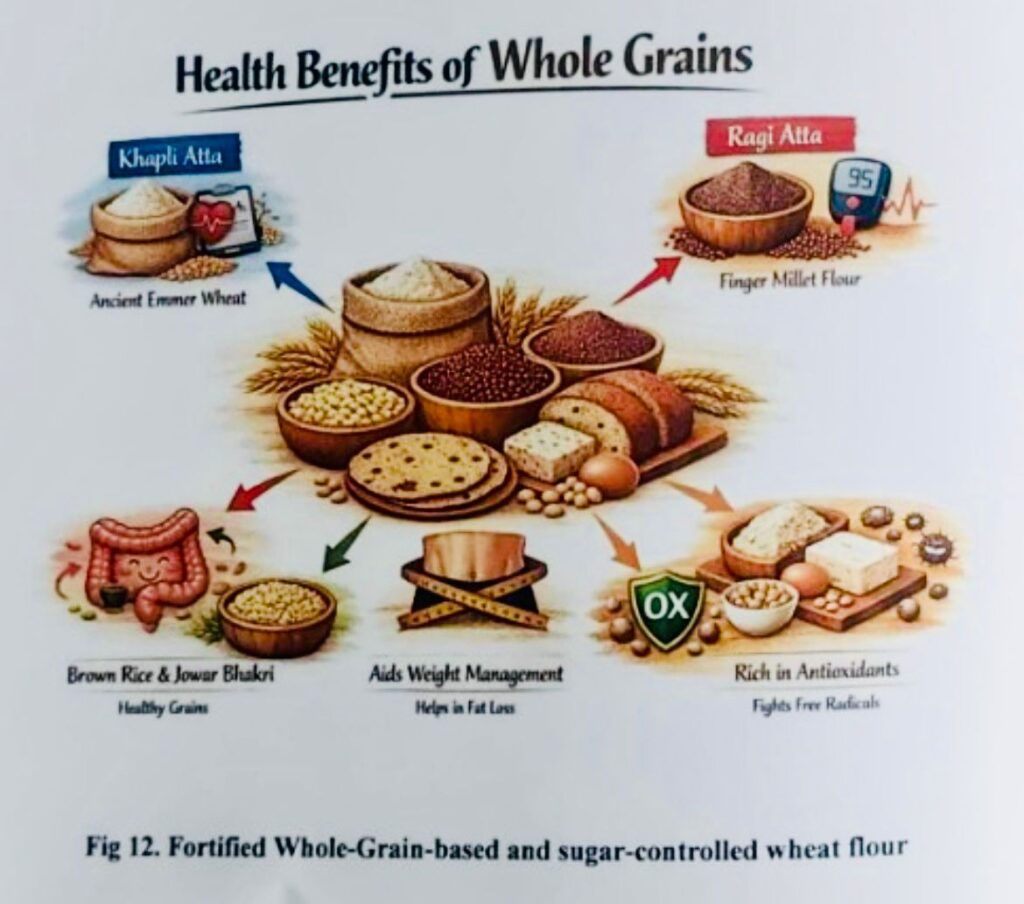
Whole grains contain fibre, vitamins and essential nutrients. Refining removes much of this, leaving behind mostly carbohydrates. The shift, therefore, is not just agricultural. It is nutritional.
The Maharashtra Paradox
Nowhere is this contradiction sharper than in Maharashtra. The state produces over a third of India’s jowar. Yet its urban population barely consumes it.
Instead, diets are dominated by refined grains, packaged foods and quick-consumption meals. The result is a new form of malnutrition — not of scarcity, but of imbalance.
People are eating enough, sometimes more than enough. But they are not eating right.
A state that grows jowar is not eating it.
Feeding Calories, Not Nutrition
India’s food architecture was designed to fight hunger — and it has succeeded in that mission.
Schemes like PDS and POSHAN Abhiyaan have ensured that food reaches households across the country. But the focus remains largely on calorie delivery, not nutritional quality.
Whole grains — which provide fibre, micronutrients and long-term health benefits — remain largely absent from these systems.
The consequence is increasingly visible.
India may be addressing hunger. But it may also be contributing to its own rising disease burden through the way food is supplied and consumed.
Are we feeding people — or are we feeding disease?
A Health Crisis in Slow Motion
The clinical evidence is now well established. Diets rich in whole grains are associated with significantly lower risks of heart disease and Type 2 diabetes.
Yet consumption remains low.
Part of the problem lies in awareness. Part lies in behaviour. Urban lifestyles increasingly favour convenience — refined flour, packaged foods, fast meals — over traditional diets.
But part of the problem is structural.
When systems prioritise quantity over quality, the outcome is predictable.
India is moving from undernutrition to lifestyle disease — without correcting the imbalance in between.
The Larger Question
India’s food policy solved one crisis — hunger.
But it has created another question that can no longer be ignored.
If food systems continue to prioritise calories over nutrition, the long-term cost will not be visible in food stocks — it will be visible in hospitals.
The plate is full. But the body is not nourished.
India’s next policy challenge is not just to ensure food security, but to ensure nutrition security.
Because the real crisis today is not how much we eat.
It is what we eat to survive.