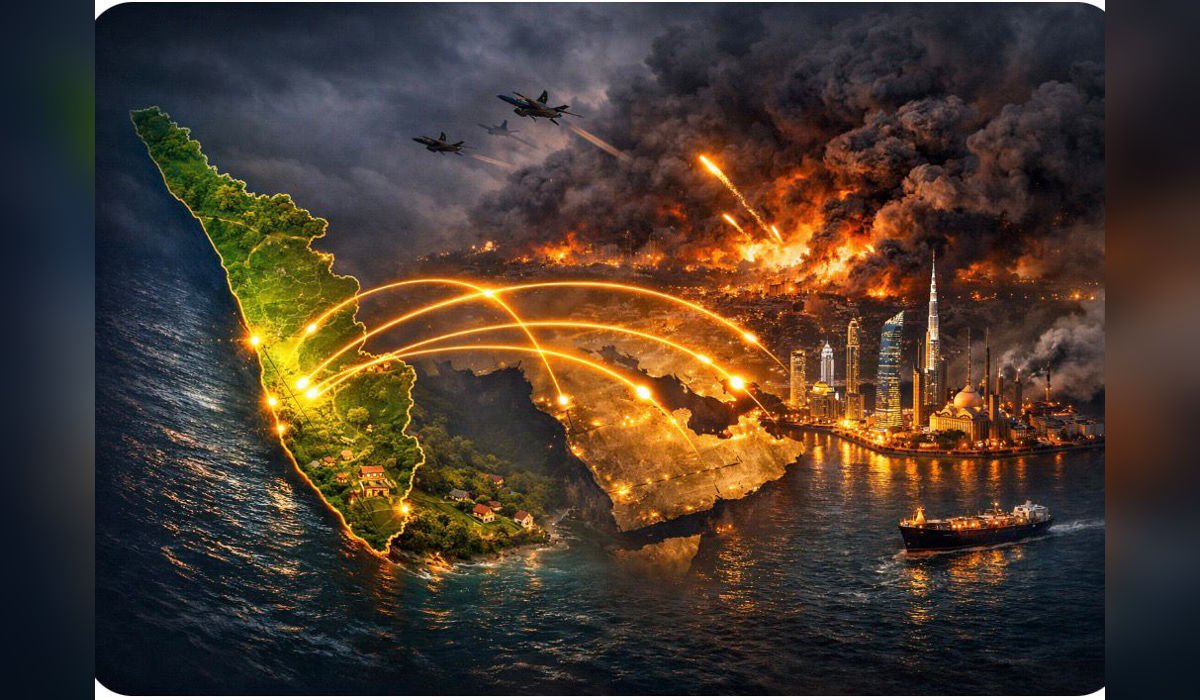
Kerala’s economy, heavily dependent on remittances from Gulf-based Malayali workers, faces uncertainty as the escalating West Asia conflict raises fears of disruption in migrant incomes and capital flows.
Thiruvananthapuram: When the Gulf sneezes, Kerala catches cold.
For long, Kerala’s financial and social security have been vitally sustained by remittances from Non-Resident Keralites (NRKs) in the Gulf states. Any substantial disruption in this cash flow could have serious implications for the state.
In such a scenario, the raging war in West Asia obviously brings bad news for countless homes across Kerala.
So far, no casualty involving Keralites has been reported amid Iran’s relentless missile and drone attacks targeting American assets and other installations in the Gulf region, in retaliation for the coordinated strikes launched against the Islamic Republic by Israel and the United States.
The initial disruptions in flight services to Gulf destinations and back have been normalised to a certain extent. However, air fares between Kerala and major Gulf aviation hubs have spiked sharply, causing concern among holiday-season travellers.
The state government’s NRK agency NORKA-Roots has conveyed that there is no reason to panic for the time being.
Migration has been a defining feature of Kerala for centuries and has played a seminal role in shaping its economy and eclectic culture.
As a historic hub of the global spice trade, Kerala’s maritime links with West Asia and the Mediterranean facilitated the movement of people and goods across regions.
Also Read: Kerala Poll Outcome to Have Long-Term Implications for Parties, Players
In modern times, large-scale Gulf migration began in the mid-20th century and gained momentum from the mid-1970s onwards, fuelled by the rise of the oil-rich Gulf economies and the surge in demand for labour.
Since then, the Gulf has remained a “promised land” for many Keralites, especially the youth, as employment opportunities within the state remain limited.
The Gulf Cooperation Council (GCC) countries — Bahrain, Kuwait, Oman, Qatar, Saudi Arabia and the United Arab Emirates — account for the largest share of the global Malayali diaspora.
Malayali migrants in the Gulf are engaged in a wide spectrum of occupations, ranging from oil and infrastructure projects to financial services, healthcare, retail, and businesses of various scales.
Almost all regions and communities of Kerala have benefited from this migration wave. Unlike in many other Indian states where migration is largely urban or community-specific, Kerala’s migration has been geographically and socially widespread, making it a more inclusive economic phenomenon.
Remittances from Gulf-based NRKs have long formed a significant share of Kerala’s Gross State Domestic Product (GSDP) and have acted as a key driver of economic growth.
They have also helped sustain property values in the state. Kerala’s construction sector, in particular, has expanded significantly over the decades largely because of remittance inflows. Any major disruption in remittances could severely affect several sectors of the state’s economy.
A prolonged war in West Asia — with Gulf states potentially caught in the crossfire — could imperil Kerala’s economy in multiple ways.
A protracted regional conflict could weaken Gulf economies themselves. Disruptions in global petroleum movement, particularly if Iran blocks the Strait of Hormuz, could destabilise these economies.
In such a scenario, migrant communities would likely be the first victims, facing job losses and wage cuts.
As the saying goes, a fortnight is a long time in war. The economic damage inflicted by any conflict often extends far beyond the cessation of hostilities. And those at the lowest rungs of society — including migrant workers — are usually the worst affected.