

In tribal regions, farming has never been merely a means of livelihood; it has been a way of life carried forward from one generation to another. Yet, as times have changed, some farmers have chosen to build upon that traditional knowledge, combining experience with fresh thinking and a willingness to experiment.
Mangalsingh Ganaga is one such farmer. Alongside conventional cultivation, he ventured into organic turmeric farming—an experiment that not only created an additional source of income for his family but also demonstrated what can become possible when traditional farming is combined with diversification, value addition and appropriate technical guidance.
His story, however, is not his alone.
His wife, Shantidevi Ganaga, has developed vegetable cultivation through a nutrition garden and turned it into another source of household income. Together, their journey offers an inspiring example of how a tribal farming family can gradually strengthen its livelihood without abandoning its relationship with the soil.
A Crop Rooted in Tradition
Turmeric has long been an inseparable part of Indian kitchens and traditional systems of medicine. Curcumin, the naturally occurring compound responsible for turmeric’s distinctive yellow colour, has also been the subject of considerable scientific interest. But beyond its traditional and cultural significance, turmeric remains an everyday ingredient in Indian households, giving the crop a broad and continuing market.
For small farmers, however, cultivating a crop is only one part of the challenge. The real difference often lies in how it is grown, processed and marketed.
Mangalsingh Ganaga’s experience illustrates precisely this possibility.
Phalwa village, situated in Anandpuri tehsil of Rajasthan’s Banswara district, is a predominantly tribal area where a large section of the population continues to depend on agriculture and animal husbandry.
Mangalsingh, a resident of the village, has cultivated different crops across both the kharif and rabi seasons for years on his six bighas of irrigated land. During the kharif season, he mainly grows maize, black gram, sesame and Patharia rice, while chickpea and wheat remain his principal rabi crops.
Animal husbandry forms an equally important part of the family’s livelihood. Mangalsingh owns four buffaloes, two bullocks, three cows and five goats. These animals provide milk and other resources for the household while also supplying something extremely important for the family’s approach to farming—organic manure.
The Desire to Try Something New
Mangalsingh’s life as a farmer began with conventional methods, but somewhere within him there had always been a desire to experiment on his land.
He had long wanted to try something beyond the crops he traditionally cultivated. What he lacked was not willingness, but appropriate guidance.
That opportunity came when he met Lalita Makwana, a community facilitator associated with VAAGDHARA.
Makwana connected him with the Gram Swaraj Samuh, through which Mangalsingh was introduced to VAAGDHARA’s Sachchi Kheti, or True Farming, programme. There, he learned more about organic farming, its methods and the importance of reducing dependence on chemical inputs.
For Mangalsingh, this was the direction his instinct for experimentation had been waiting for.
The guidance encouraged him to gradually reduce his dependence on chemical fertilisers and pesticides and make greater use of locally available organic resources. Cow-dung manure from his own livestock became an important input, while preparations such as dashparni extract were used according to the needs of the crop.
But Mangalsingh did not simply replace one agricultural input with another.
He began thinking differently about the farm itself.
Turmeric Alongside Maize
One distinctive aspect of Mangalsingh’s experiment was his decision to continue cultivating maize alongside turmeric on the same land.
This mixed-cropping approach allowed him to avoid depending entirely on a single crop and gave the household another layer of livelihood security.
There was another equally important decision.
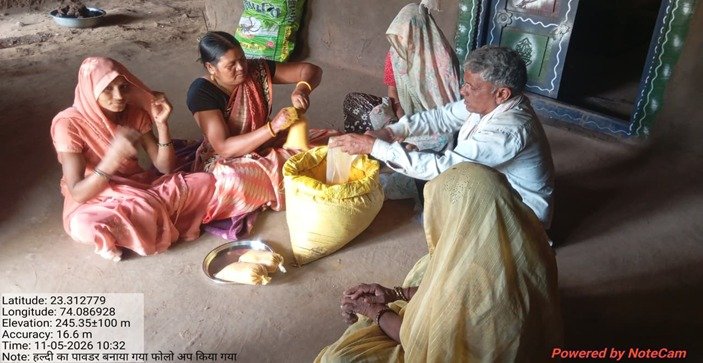
Instead of restricting himself to selling turmeric only in its raw form, Mangalsingh explored the possibility of processing part of the produce into turmeric powder before selling it.
That seemingly simple step represented something extremely important for a small farmer: value addition.
When farmers sell only raw produce, much of the value created through processing, packaging and marketing is captured elsewhere in the supply chain. By processing turmeric himself, Mangalsingh attempted to retain a greater share of that value within his own household.
Five Kilograms of Seed and an Experiment
Under VAAGDHARA’s Sachchi Kheti programme, Mangalsingh was provided five kilograms of turmeric seed to begin the experiment.
He planted it on a plot measuring approximately 20 feet by 25 feet and applied around 400 kilograms of cow-dung manure, sourced largely from his own livestock.
Technical guidance came through the Farmer Field School facilitated by VAAGDHARA, where farmers were introduced to different stages of cultivation, from sowing and crop management to harvesting.
Mangalsingh sowed the turmeric during the first week of July 2025 and harvested it in May 2026.
According to his account, the five kilograms of seed produced approximately 60 kilograms of turmeric.
He sold around 20 kilograms of raw turmeric at ₹150 per kilogram, earning approximately ₹3,000.
Mangalsingh says another portion of the harvest was processed into turmeric powder and marketed at around ₹400 per kilogram, generating approximately ₹12,000. About 10 kilograms were retained for household requirements and for use as seed in the following cultivation cycle.
According to the figures shared by him, turmeric cultivation generated approximately ₹15,000 in sales income from this relatively small experimental plot.
For Mangalsingh, however, another encouraging development was that he did not have to travel far in search of buyers.
People who purchased the turmeric began recommending it to others, particularly because it had been cultivated using organic methods. Word of mouth gradually helped create a local market for his produce.
What had begun with just five kilograms of seed was beginning to demonstrate something larger: even on a small piece of land, cultivation combined with processing and local marketing could create an additional income opportunity.
Shantidevi Builds Another Source of Livelihood
Yet, the transformation taking place within the Ganaga household cannot be understood through Mangalsingh’s turmeric crop alone.
His wife, Shantidevi Ganaga, has played an equally significant role in strengthening the family’s livelihood.
While Mangalsingh experimented with turmeric, Shantidevi developed another dimension of the household’s farming system—one centred on vegetables, nutrition and regular income.
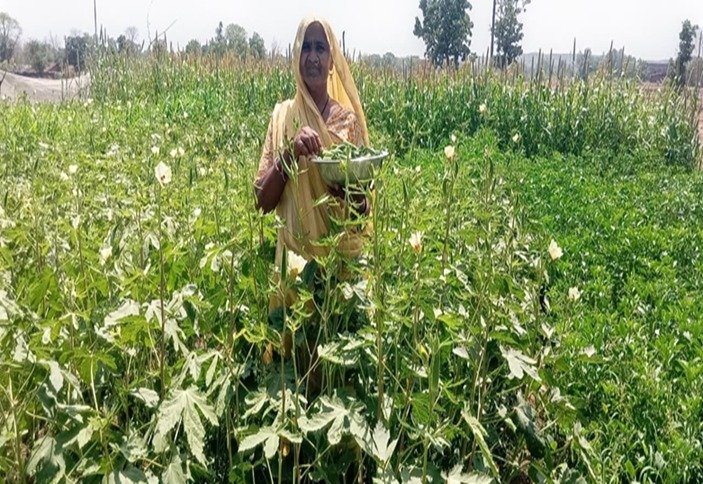
Through a Poshan Vatika, or nutrition garden, initiative, she received a vegetable kit containing seeds for crops including okra, cowpea, bottle gourd, ridge gourd, tomato, brinjal, cluster beans, fenugreek, spinach and chilli.
What began as an initiative aimed at improving household nutrition gradually became something more.
The vegetables grown by Shantidevi helped provide the family with a regular supply of fresh produce. The surplus could then be sold, creating an additional stream of income.
According to Shantidevi, vegetable sales over the year generated approximately ₹60,000 for the household.
For a small farming family, that contribution is significant.
It also demonstrates why the concept of a nutrition garden need not be viewed only through the lens of household consumption. When production exceeds family requirements, the same small plot can potentially contribute to both nutrition and income.
Shantidevi credits the guidance she received with encouraging the family to adopt organic cultivation and diversify its livelihood. But her experience also demonstrates something equally important: women in farming households are not merely assisting agriculture—they are producers in their own right, contributing directly to household food security and income.
Learning Beyond the Field
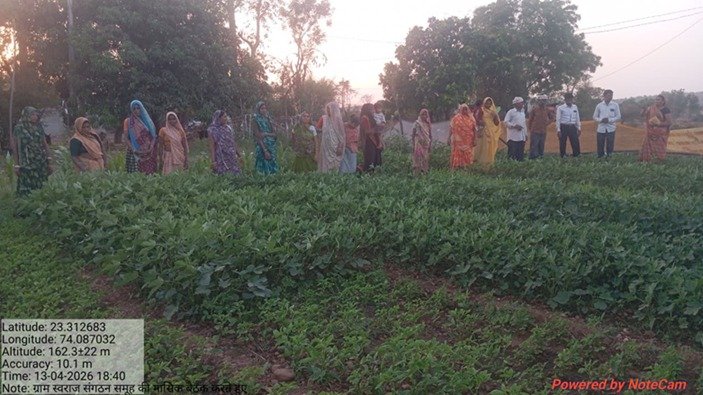
Both Mangalsingh and Shantidevi have continued participating in the Farmer Field School, where community facilitators share practical knowledge related to organic cultivation.
Such programmes do more than impart technical information.
They also create a space where farmers can exchange experiences, discuss what has worked and what has failed, learn from one another and develop the confidence to experiment.
Throughout Mangalsingh and Shantidevi’s journey, the role of community facilitators has therefore been important. Their contribution has not been limited to providing agricultural advice; it has also involved encouraging farmers to recognise the possibilities available within their own land, livestock and traditional knowledge.
Initiatives such as the Farmer Field School and nutrition gardens demonstrate how relatively small interventions can contribute to change at the grassroots.
The benefits are not necessarily confined to income. Reducing dependence on chemical inputs, using livestock manure, diversifying crops and producing vegetables for household consumption can together contribute to a farming system that seeks to strengthen livelihoods while protecting soil health and local resources.
Diversification as Security
Perhaps the most important lesson emerging from Mangalsingh and Shantidevi’s experience is the value of diversification.
For a small farmer, dependence on a single crop always carries risk. A poor monsoon, pest attack, disease or sudden fall in market prices can severely affect the family’s income.
The Ganaga household has gradually created several layers of livelihood within the same farming system.
Their grain crops meet traditional agricultural needs. Turmeric provides a higher-value crop with the possibility of processing and value addition. Shantidevi’s vegetables contribute both nutrition and cash income. Livestock provides milk, farming support and organic manure.
Each activity strengthens the others.
If one crop performs poorly, the family is not left entirely without alternatives.
That is what makes diversification particularly relevant for small and tribal farmers confronting increasingly uncertain climatic and market conditions.
A Small Experiment With a Larger Message
Mangalsingh Ganaga did not transform his farm through an enormous investment. His turmeric experiment began with just five kilograms of seed, a small plot of land, manure available from his own livestock and the willingness to learn something new.
Shantidevi’s journey, too, began with a vegetable kit intended for a nutrition garden.
Yet together, these relatively small interventions have contributed to a more diversified household economy.
Their experience reminds us that agricultural development does not always have to begin with large infrastructure or expensive technology. Sometimes it begins with something much simpler—a farmer receiving the right guidance at the right time, making better use of resources already available within the household, experimenting carefully, and learning how to retain more value from what the land produces.
For Mangalsingh and Shantidevi, the journey from traditional cultivation towards organic and diversified farming is still continuing. Their experience cannot be treated as a universal formula for every farmer, because agricultural conditions, markets, water availability and household resources differ from place to place.
But their story certainly offers an example worth considering.
It shows how traditional knowledge can coexist with experimentation, how farming and animal husbandry can complement each other, how value addition can improve the potential return from agricultural produce, and how women’s contribution can strengthen the economic resilience of an entire farming household.
Through the dedication of farmers like Mangalsingh and Shantidevi, organic and diversified farming can become more than an agricultural practice. It can become a pathway towards greater self-reliance—one that strengthens the family’s economic position while encouraging healthier soil, locally produced food and a more sustainable relationship with the land.
For a farming family in Phalwa, that journey began with a simple desire to try something new.
And sometimes, that is precisely where transformation begins.
Author Bio — Vikas Meshram
Vikas Meshram writes on agriculture, rural development, tribal communities, environment and grassroots social change. His work focuses on the everyday realities of farmers and rural communities, highlighting both structural challenges and community-led solutions. Through field-based narratives and policy-oriented analysis, he explores issues of sustainable livelihoods, food and water security, women’s participation and the changing rural economy.
The views expressed are those of the author.


