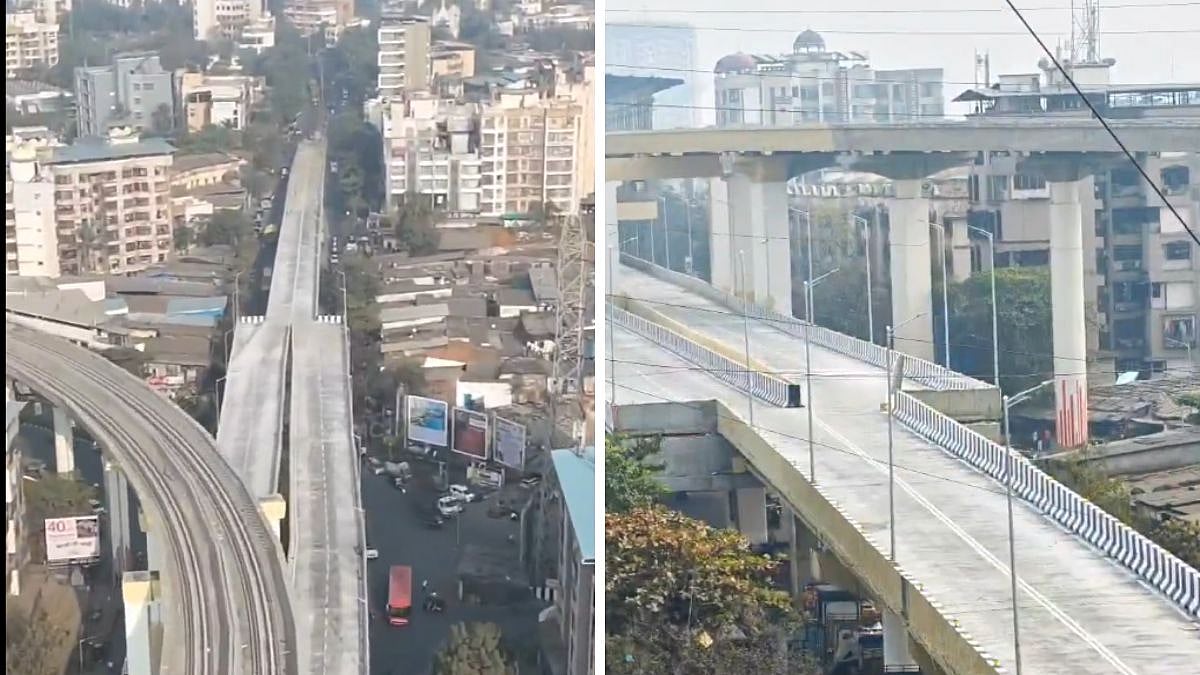
Mumbai: The Mumbai Metropolitan Region Development Authority (MMRDA) has stepped in to address mounting online criticism surrounding the newly built flyover in the Mira–Bhayandar belt, clarifying that the narrowing of lanes was a conscious planning decision and not a structural mistake.
Over the past few days, social media platforms have been flooded with visuals and posts questioning why a four-lane flyover suddenly narrows into two lanes, triggering concerns about congestion and safety. Responding to the backlash, MMRDA issued a detailed explanation, asserting that the flyover’s design is aligned with existing road width, traffic patterns, and long-term connectivity goals.
According to the authority, the flyover has been conceptualised as a 2+2 lane corridor—two lanes currently operational towards Bhayandar East, while the remaining two lanes are planned to connect Bhayandar West in the future via a proposed crossing over the Western Railway tracks. Since the eastern arm was completed first, traffic presently funnels into two lanes.
The project primarily aims to decongest Golden Nest Circle, a notorious traffic choke point where five major arterial roads intersect. Officials claim that the flyover, when fully integrated with the metro corridor and supported by slip roads on both sides, will significantly streamline vehicular movement through the junction.
MMRDA further explained that road width beyond the junction towards Bhayandar East is restricted as per the Development Plan. Keeping this limitation in mind, engineers opted for a 1+1 lane elevated stretch with dedicated entry and exit ramps along the median to ensure uninterrupted traffic flow towards Railway Phatak Road.
Importantly, the authority has assured that the structure has been future-proofed. Provisions have already been made to expand the flyover by adding one additional lane on each side, subject to approvals and coordination with the Mira-Bhayandar Municipal Corporation (MBMC).
In terms of safety, officials confirmed the installation of multiple preventive measures, including rumble strips, reflective markers, crash barriers, clear signage, and lane delineators. Traffic police inputs are also being incorporated before the flyover is opened to the public.