A high-level seminar in New Delhi highlights the contradictions shaping India–China ties — cooperation amid distrust, economic interdependence amid geopolitical rivalry.
New Delhi: As India and China mark 75 years of diplomatic engagement, the relationship stands at a complex crossroads — shaped as much by economic interdependence as by deep-rooted strategic distrust.
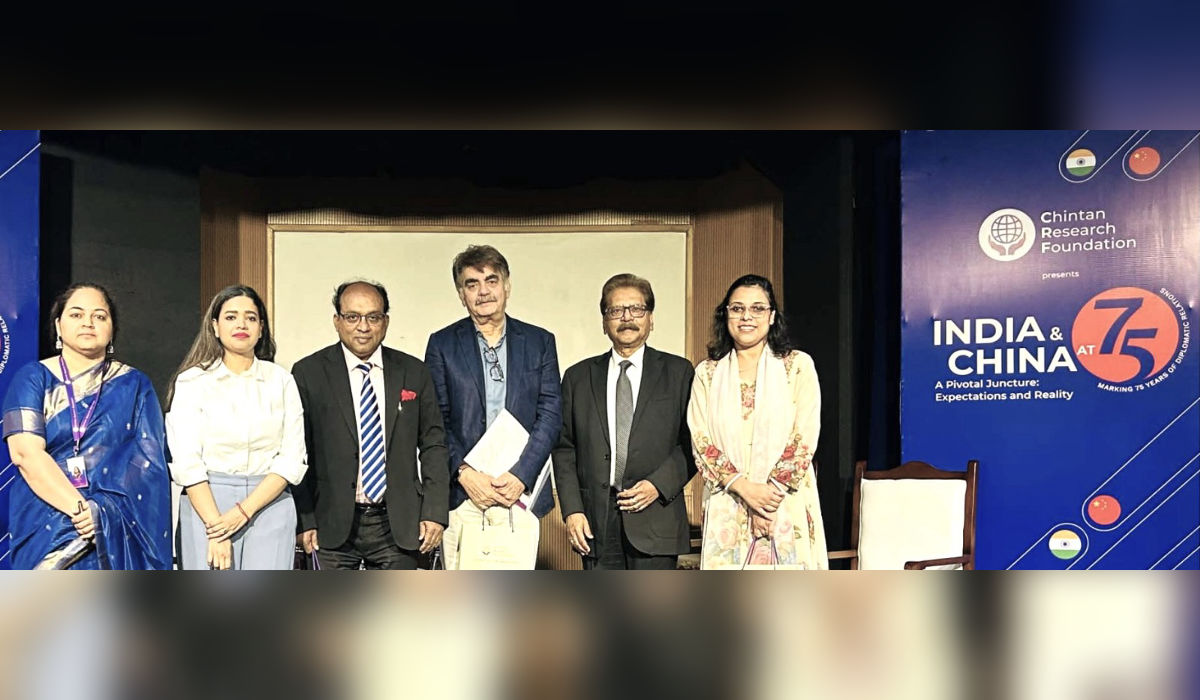
A seminar titled “India and China at 75 – A Pivotal Juncture: Expectations and Reality”, organised by the Chintan Research Foundation (CRF) on March 17, brought together policymakers, academics, and strategic experts to assess the evolving contours of bilateral ties.
The discussions come at a time when India–China relations are witnessing cautious stabilisation following Prime Minister Narendra Modi’s meeting with Chinese President Xi Jinping in Kazan in October 2024, followed by another interaction on the sidelines of the SCO Summit in Tianjin in August 2025. These engagements signal attempts to manage tensions arising from the unresolved border dispute while exploring limited areas of cooperation.
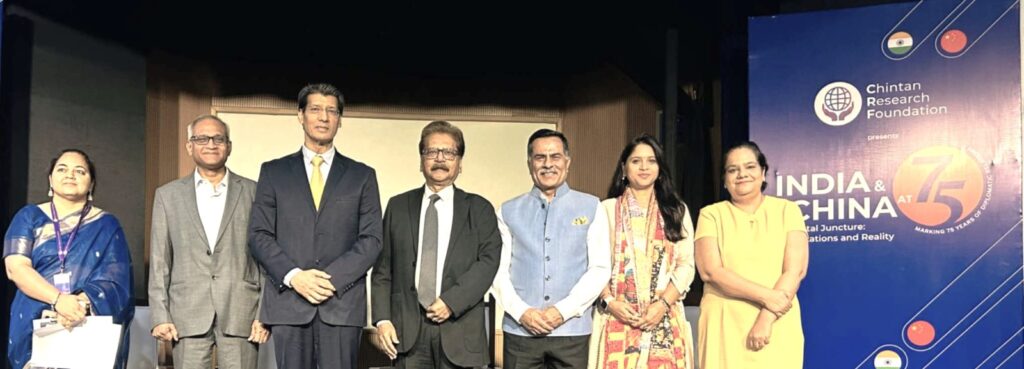
At the seminar, experts highlighted that despite persistent geopolitical friction, the relationship continues to be anchored in multiple institutional mechanisms. Shri M. Jamshed, Distinguished Fellow at CRF, pointed out that more than thirty dialogue platforms exist between the two countries across political, economic, and cultural domains. These channels, he noted, allow both sides to maintain communication even during periods of tension.
However, speakers underlined that structural asymmetry remains a defining feature of the relationship. Prof. B. R. Deepak of Jawaharlal Nehru University observed that four decades of China’s rapid economic growth have created a strategic imbalance, widening the gap between the two nations and complicating efforts at parity.
Adding to this perspective, Prof. Srikanth Kondapalli highlighted that China’s approach to India is shaped by multiple internal actors — including the Communist Party, the Foreign Ministry, the People’s Liberation Army, commercial lobbies, and elite perceptions — each influencing Beijing’s policy calculus.
At the same time, areas of potential convergence were also identified. Dr. Pooja Bhatt of O.P. Jindal Global University pointed to shared maritime interests in the Indian Ocean Region as a possible space for cooperation. Similarly, discussions around climate negotiations and global governance suggested that coordinated positions by India and China could reshape multilateral frameworks.
Economic realities also formed a key part of the debate. Mohammad Saqib of ICEC emphasised that India’s domestic consumption alone may not sustain long-term growth, making integration into global value chains essential. In contrast, Antara Ghoshal Singh of ORF flagged underlying weaknesses in China’s economic performance, including demand contraction and discrepancies between official growth figures and ground realities.
The broader geopolitical backdrop — including shifting global trade dynamics and rising protectionism — adds another layer of complexity. Experts noted that evolving global alignments could push both India and China towards selective cooperation, even as strategic mistrust persists.
The seminar, led by Dr. Bhavna Singh, Visiting Fellow at CRF, underscored a central reality: India–China relations are unlikely to follow a linear trajectory. Instead, they will continue to oscillate between competition and cooperation, shaped by both domestic priorities and global power shifts.