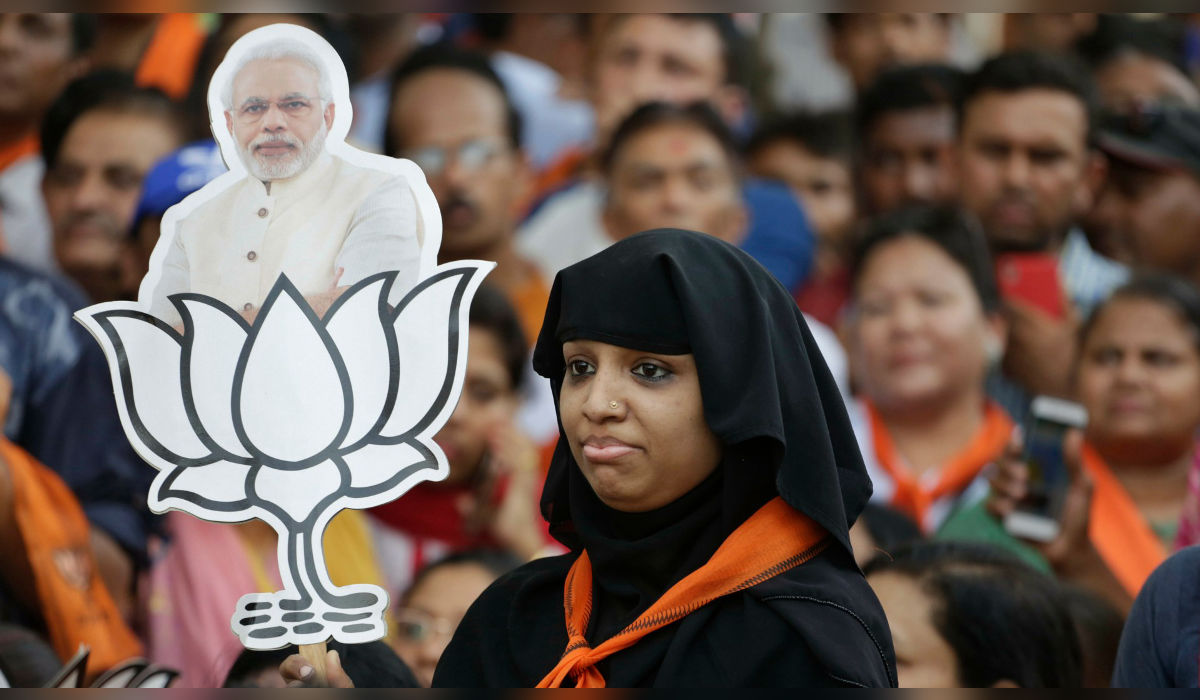
Mumbai: As elections approach in Maharashtra, the Muslim community once again finds itself at a political crossroads. Traditionally, a large section of Muslim voters has believed that parties such as the Congress and other so-called secular formations — including the Samajwadi Party, AIMIM, BSP, NCP and others — would naturally stand by them in difficult times.
Because of this long-standing belief, Muslim votes have often been split among multiple parties, weakening the community’s collective political bargaining power over the years.
On the other hand, the Bharatiya Janata Party (BJP) has openly distanced itself from Muslim vote-bank politics. Several BJP leaders have publicly stated that they do not seek Muslim votes. One of the most controversial remarks came from Union Minister Giriraj Singh, who said he did not want the votes of “namak haraams” (betrayers) — referring to sections of the Muslim community who, according to him, do not vote for the BJP despite benefiting from government welfare schemes.
The statement drew sharp criticism and further strengthened the perception that the BJP remains distant from Muslim voters.
However, ground-level interactions now indicate a gradual shift in thinking within parts of the Muslim community. Many voters are beginning to question whether repeatedly supporting the same parties — while completely rejecting the BJP — has actually delivered tangible benefits.
Increasingly, development, local work and performance are emerging as more important factors than party identity.
With the Maharashtra municipal elections approaching, conversations with residents suggest a noticeable change in mindset. People say they are willing to vote for leaders who deliver results, irrespective of party affiliation.
Irshad Mekrani, a resident of a Muslim-majority area in Mira-Bhayandar, told TheNews21, “I will vote for the BJP if they work for us. Our MLA Narendra Mehta has worked for Mira-Bhayandar. Despite being a BJP leader, he has done development work in our area, which has a large Muslim population.”
Religious leaders are also increasingly advocating a practical voting strategy.
Maulana Rizwan Warsi said the community should support anyone who works sincerely and promotes harmony. “People should vote for those who work for them. It can be anyone. Just remember, work should be done. Select your leader based on performance,” he said.
Another resident, Farhan Siddique, pointed out that supporting a BJP leader does not automatically mean acting against Muslim interests.
He noted that several government schemes are benefiting Muslims as well, and that tensions are often fuelled by fringe elements. “Voting for any leader — BJP or otherwise — is fine, as long as they work for all communities,” he said.
These voices indicate that Muslim voters are becoming more conscious of their political leverage. The emphasis is slowly shifting from identity-based voting to performance-based decision-making.
If this trend continues, it could significantly influence the outcome of the upcoming municipal elections in Maharashtra — and possibly reshape electoral behaviour beyond the state as well.