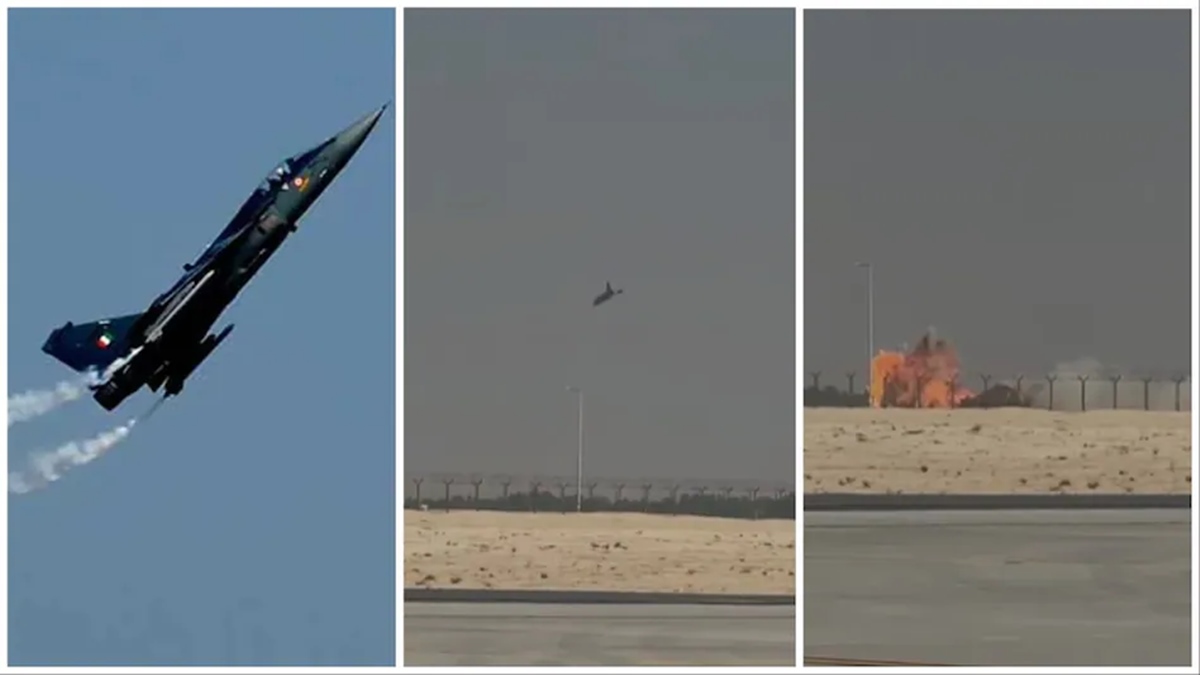
New Delhi: The crash of an Indian Air Force Tejas fighter during an aerobatic display at the Dubai Air Show has understandably drawn widespread attention. Air accidents — especially those involving indigenous platforms — tend to attract immediate scrutiny, commentary, and a rush to assign meaning. But not all flying, and not all accidents, are equal. A display sortie is a world apart from routine training or operational missions, and it must be understood within that very frame.
Aerobatics: A Specialised, High-Risk Category of Flying
Air shows represent the pinnacle of precision flying. They are carefully choreographed demonstrations that push aircraft to the outer boundaries of their aerodynamic and structural capability. Manoeuvres executed at higher altitudes during training are compressed vertically and horizontally to remain within spectator view. These constraints significantly reduce the margin for recovery in the event of a system malfunction, loss of control, or unexpected aerodynamic disturbance.
This reality is not unique to India. The world’s most experienced demonstration teams — from the USAF Thunderbirds and Navy Blue Angels to the RAF Red Arrows and France’s Patrouille de France — have all suffered losses despite flying mature platforms. The common denominator in every case is the inherent risk of display flying, not the country or aircraft involved.
Why Historical Comparisons Are Misleading
In the immediate aftermath of the Tejas crash, some voices invoked decades-old statistics about India’s fighter accident rates, attempting to draw a line from the past to the present. This is an analytical error. Comparing an aerobatic accident with “through the ages” crash data — spanning earlier generations of technology, different operating environments, and variable maintenance ecosystems — muddles far more than it clarifies.
Even recent comparisons, limited to the last five years and grounded in metrics such as aircraft strength or flying hours, do not apply. Air-show sorties are not representative of routine flying patterns. They are isolated, high-stress profiles flown under conditions that compress time, altitude, and performance envelopes. Accident rates based on fleet operational hours cannot be used to interpret the extremely narrow margins under which display aircraft operate.
The Question of Ejection: A Complex, Technical Reality
One question inevitably arises after any crash: why did the pilot not eject?
Public curiosity is natural, but conclusions must be grounded in the physics and mechanics of ejection systems. Modern seats do offer “zero-zero” capability — zero altitude, zero airspeed — but only when the aircraft is upright and in a stable attitude. At low levels, even a fraction of a second spent inverted, in a steep bank, or under high G-forces can render safe ejection impossible.
The feasibility of ejection depends on several factors:
- Altitude and attitude at the moment of failure
- G-loads, which can physically prevent a pilot from reaching or pulling the ejection handle
- Reaction time — which in low-level aerobatics may shrink to less than a second
- Pilot judgement — especially when prioritising trajectory control to avoid endangering spectators
These parameters will be known only after detailed flight-data analysis. Until then, attributing the outcome solely to pilot decision is premature and unfair.
Aviation Demands Discipline — and Perspective
Fighter flying is one of the most unforgiving professions in the world. It sits at the intersection of physics, physiology, and human skill. Display flying sharpens each of these elements into a narrower, harsher frame. The risk cannot be eliminated — only managed — and even the most advanced nations have paid similar prices.
The Tejas platform itself has demonstrated reliability across thousands of flying hours. An isolated accident, especially in such a specialised environment, cannot be read as a referendum on the aircraft’s overall safety or capability. India’s aviation ecosystem has matured substantially, and part of that maturity lies in resisting the temptation to draw sweeping conclusions from a single event.
What Matters Now
The focus should remain on a rigorous, transparent investigation grounded in data and aeronautical science. Beyond that, a broader perspective must be preserved: air-show accidents, however visible and unfortunate, are not indictments of a nation’s aviation programme. They are reminders of the inherent risks that pilots accept when they strap into high-performance machines — risks magnified at air shows, where margins are intentionally narrow and the stakes globally visible.
India, like every aviation nation before it, will learn, adapt, and move forward. That is how aviation progresses — steadily, technically, and without surrendering to noise.
About the Author:
Lt Gen Anil Puri, PVSM, AVSM, SM, VSM (Retd), commanded the front-line Desert Corps and later served as the Deputy Chief and the first Additional Secretary of the Department of Military Affairs (DMA), Ministry of Defence. Known for his strategic vision and reform-driven leadership, he writes on national security, governance, and ethics in public life.