

Let’s not pretend otherwise: Nikkhil Advani’s The Revolutionaries can be exhausting.
Across eight episodes and nearly seven hours, the Prime Video period drama repeatedly loses momentum. Its romantic track between Sachindra Nath Sanyal and Pratibha Lahiri is stretched far beyond what the story needs, while certain emotional revelations are revisited even after the audience has already understood where they are headed.
Reviews of the series have landed all over the spectrum — from disappointment over its pacing and glossy treatment of history to enthusiastic praise for its scale, performances and attempt to bring lesser-known revolutionaries into popular memory.
Yet even when The Revolutionaries drags, there are moments, performances and historical strands that make abandoning it halfway feel like a mistake.
If you are struggling to finish the series, here are five reasons to keep going.
1. Bhuvan Bam as Rash Behari Bose
Bhuvan Bam’s casting as Rash Behari Bose may initially sound like a gamble.
An entertainer who built much of his early fame through YouTube comedy and solo character sketches is being asked to play one of the most elusive figures in India’s revolutionary movement.
Surprisingly, it works.
Bam’s Bose operates through contradiction. In public, he can appear mild, eccentric and almost excessively anglicised — a professor in Dehradun mocked for seeming “more British than the Britishers”. Beneath that performance sits a man organising armed resistance and constantly calculating his next move.
The series opens with Bose declaring, “Jeetne wala hi itihaas likhta hai” — the winner writes history.
But Bam is actually more effective when he is not delivering declarations.
His strongest moments come when the performance becomes quieter: restrained anger, suspicion, exhaustion and the awareness that arrest could come at any moment. Instead of trying to play Bose as a permanently fiery revolutionary, Bam allows him to disappear behind the masks that survival demands.
That restraint is one of the series’ genuine surprises.
2. Paoli Dam Makes a Small Role Matter
Paoli Dam does not dominate the running time of The Revolutionaries, but she does something perhaps more valuable: she makes you wish the series had spent more time with her.
Dam plays Nanibala Devi, one of the women associated with revolutionary underground networks of the period.
Her presence points towards an aspect of the freedom struggle that popular cinema still explores far too rarely — the women who carried messages, sheltered fugitives, moved through networks of surveillance and resistance, and endured consequences that were often no less severe than those faced by the men around them.
Several reviews have singled out Dam’s performance despite the limited screen time she receives.
There is no need for grand speeches here. Dam brings weariness, resolve and emotional force to the role almost entirely through presence.
She gives the character more weight than the screenplay consistently allows her.
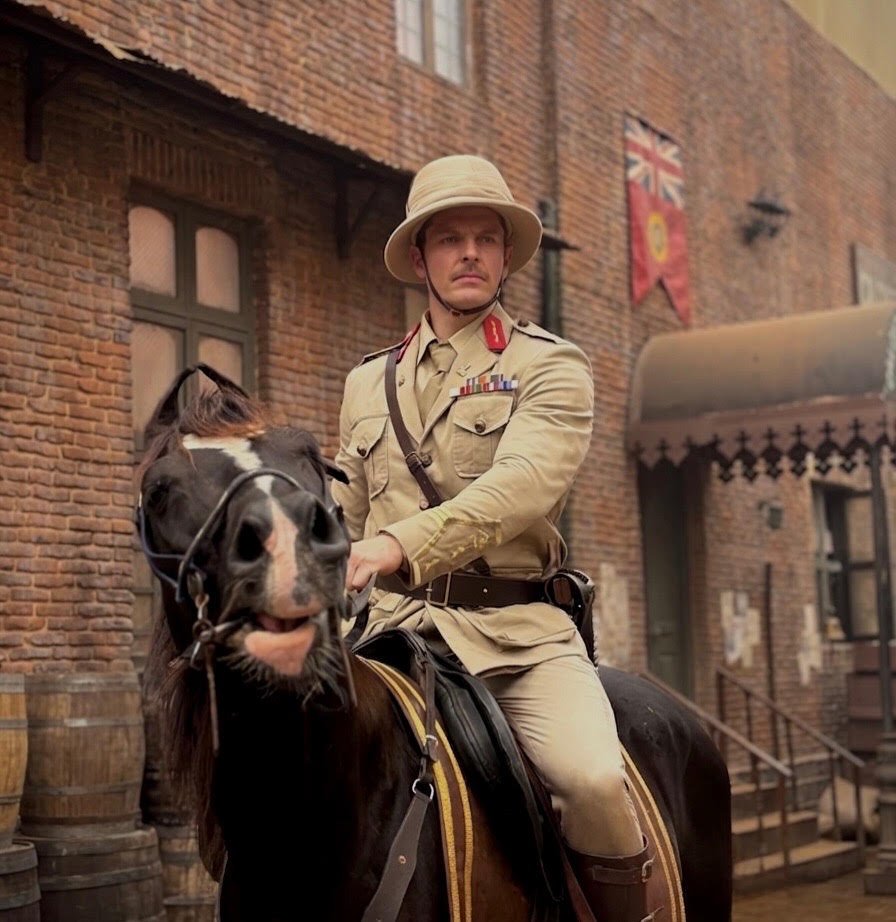
3. Jason Shah’s Dyer Is More Disturbing Than a Cartoon Villain
Colonial officers in historical dramas are often written in the easiest possible register: cruel, sneering and obviously monstrous.
The Revolutionaries tries something more unsettling with Jason Shah’s Dyer.
Rather than presenting him simply as an embodiment of evil, the series gives him insecurity, humiliation and fragments of personal history. He does not appear to think of himself as a villain.
That makes him more disturbing.
The performance suggests a man capable of cruelty while remaining convinced of his own righteousness — a far more interesting dramatic choice than reducing him to a caricature.
Shah’s controlled performance is also one of the reasons the cat-and-mouse sections of the series work even when the larger narrative becomes overextended. Critics who disagreed sharply about the series as a whole have nevertheless singled out its treatment of Dyer as one of its more interesting character choices.
There is, however, an important historical distinction: this is dramatised history, not a literal reconstruction. The real Rash Behari Bose and Reginald Dyer did not conduct the personal pursuit depicted by the series.
That distinction matters.
4. It Dramatises History We Rarely See on Screen
Whatever one thinks of its execution, The Revolutionaries deserves credit for where it chooses to look.
Indian screen depictions of the freedom struggle repeatedly return to a relatively familiar set of events and personalities. This series moves towards revolutionary networks operating outside the better-known Congress-centred narrative.
The Ghadar movement, the Komagata Maru episode, Rash Behari Bose, Bagha Jatin and transnational revolutionary networks all receive significant space.
That alone makes the series interesting.
The sections involving Indians abroad and the treatment of passengers linked to the Komagata Maru story are among the moments when the scale of the project begins to justify itself. The series reminds viewers that resistance to British rule was not confined to meetings or protests within India; revolutionary networks extended across borders and connected activists in India with communities overseas.
This larger network is also central to Sanjeev Sanyal’s book on which the series is based. The book argues that armed resistance operated as an interconnected movement over roughly half a century, with links extending far beyond India.
For viewers familiar mainly with later figures such as Bhagat Singh and Chandrashekhar Azad, The Revolutionaries offers an entry point into an earlier phase of organised armed resistance.
Even when the storytelling falters, that history remains compelling.
5. Rohit Saraf Pushes Beyond His Familiar Screen Image
Rohit Saraf’s Sachindra Nath Sanyal is one of the series’ quieter strengths.
Saraf has frequently been associated with softer romantic roles, so placing him inside a story of underground networks, weapons, political conviction and sacrifice requires a different kind of performance.
He largely rises to it.
His Sanyal is not built around swagger. Instead, Saraf plays him as a young man gradually understanding the personal cost of choosing revolution over an ordinary life.
The romantic storyline with Pratibha Lahiri is also where the series tests the audience’s patience most severely. What begins as an emotional counterpoint to the revolutionary story eventually becomes overworked.
But Saraf remains controlled even when the writing surrounding him becomes repetitive.
The role also marks a visible attempt to move outside his established screen persona — something reflected in the extensive physical preparation he undertook for the part.
Gurfateh Pirzada’s Bagha Jatin gets comparatively less room, but he carries considerable presence whenever the series turns its attention to him.
Together, the younger cast manages to keep the story emotionally alive even when its structure begins to sag.
So, Is The Revolutionaries Worth Finishing?
Not every viewer will think so.
The pacing problems are real. The middle stretch can feel unnecessarily prolonged, the romance receives more emphasis than it can sustain, and the series occasionally confuses visual grandeur with narrative momentum.
It also freely combines historical fact with dramatic invention, so anyone watching it as an introduction to the period would be wise to distinguish between the people and movements that existed and the situations created for the screen.
But The Revolutionaries does something that matters.
It makes viewers curious.
About Rash Behari Bose. About Bagha Jatin. About Sachindra Nath Sanyal. About Nanibala Devi. About the Ghadar movement and the international networks through which Indian revolutionaries tried to challenge an empire.
A historical drama does not have to function as a textbook. But at its best, it should make you want to open one after the credits roll.
The Revolutionaries manages that — even if getting to those credits sometimes feels like work.
Where Does the Story of The Revolutionaries Come From?
The series is adapted from Sanjeev Sanyal’s 2023 non-fiction book Revolutionaries: The Other Story of How India Won Its Freedom.
The book takes a much broader view than the television adaptation. It traces a connected tradition of armed resistance to British rule across roughly half a century and discusses figures including Vinayak Savarkar, Aurobindo Ghosh, Rash Behari Bose, Bagha Jatin, Sachindra Nath Sanyal, Bhagat Singh, Chandrashekhar Azad and Subhas Chandra Bose.
The Prime Video series narrows that sprawling history to one part of the story, concentrating principally on Rash Behari Bose, Sachindra Nath Sanyal, Pratibha Lahiri, Bagha Jatin and the revolutionary networks of the early 20th century. Prime Video describes the eight-part drama as being based on Sanyal’s book and led by Bhuvan Bam, Rohit Saraf, Pratibha Ranta and Gurfateh Pirzada.
The Revolutionaries is now streaming on Prime Video.


