

In Rajasthan’s tribal heartland, one woman’s journey shows how livestock, natural farming, nutrition gardens and community learning can transform a rural household
About 42 kilometres from Rajasthan’s Banswara district lies Ubapana, a small village in the tribal heartland of Ghatol block. This is where Kalawati Ninama and her family live, in a setting where daily life moves with the rhythm of farming, livestock and hard physical labour. Kalawati, who studied up to Class VIII, lives with her husband Dhulji Ninama and their four children. Like many families around them, their mornings begin early, afternoons are spent in the fields, and evenings are devoted to caring for animals.
For years, farming and livestock were only a means of survival for the family. Today, they have become the foundation of self-reliance. With limited resources, Kalawati and Dhulji transformed their household economy through hard work, better livestock care, natural farming methods, a nutrition garden and effective use of local resources. In the process, Kalawati herself became an example for other women in the area. A decade ago, the family owned fewer than 20 animals. Farming and animal husbandry continued side by side, but neither brought enough income to meet the household’s needs. Even during a good monsoon, the land did not produce enough grain for the entire year. The small herd could not provide reliable income. As a result, the family often had to depend on wage labour. Whenever Dhulji left the village in search of work, the burden of the household, children, fields and livestock fell almost entirely on Kalawati. Her day began before sunrise. She fed and watered the animals, tended the fields, managed the children and carried the household forward. It was not easy, but she refused to give up.
The turning point came in 2021, when Kalawati and Dhulji came in contact with VAAGDHARA. Through the efforts of Manilal Damor, the facilitator working in their village, the family began receiving guidance through the Saksham Samuh and Gram Swaraj Samuh. These groups were built around the idea of strengthening honest farming, responsible livestock-rearing, local self-reliance and better use of government schemes and community resources. The meetings were not merely sessions for passing on information. They became spaces where village women could sit together, discuss their problems, learn from one another and share practical experiences. Kalawati listened carefully in every meeting. Whatever she learnt, she tried to apply in her own fields and courtyard. If something was not clear, she asked the facilitator to explain it again. This willingness to learn and persist became her greatest strength. Gradually, the family’s farming practices began to change.
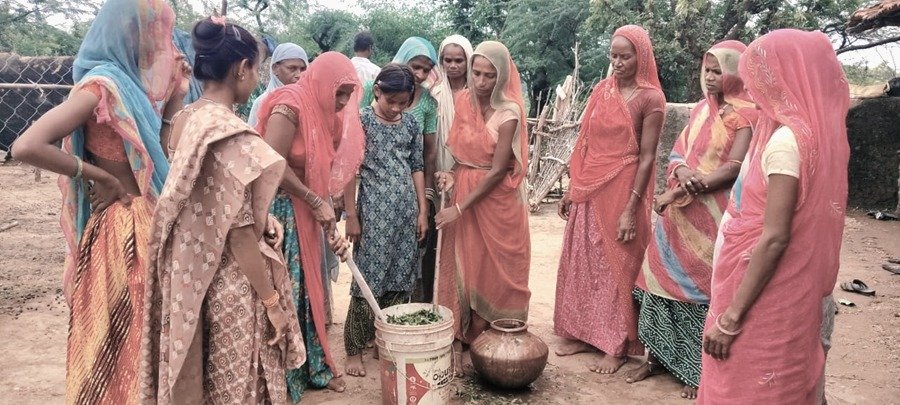
Kalawati started using homemade organic preparations such as dashparni, jeevamrit, neemastra, kandapani and brahmastra. These natural alternatives helped reduce dependence on chemical fertilisers and pesticides. Since most of the ingredients were available around the house and farm, the cost was low and the family’s dependence on the market decreased. Alongside natural farming, she also adopted better livestock practices. Animals were vaccinated on time. Mineral supplements were given to goats. Cattle dung was converted into compost. The family also used the ukeda method to decompose waste and turn it into fertiliser. Kalawati and Dhulji also worked steadily to expand their livestock. A herd that once had fewer than 20 animals has now grown to around 80 sheep, 18 goats, two bullocks, four buffaloes and 35 hens. This growth did not happen overnight. It came through careful care, protection of young animals, timely vaccination and constant attention to animal health.
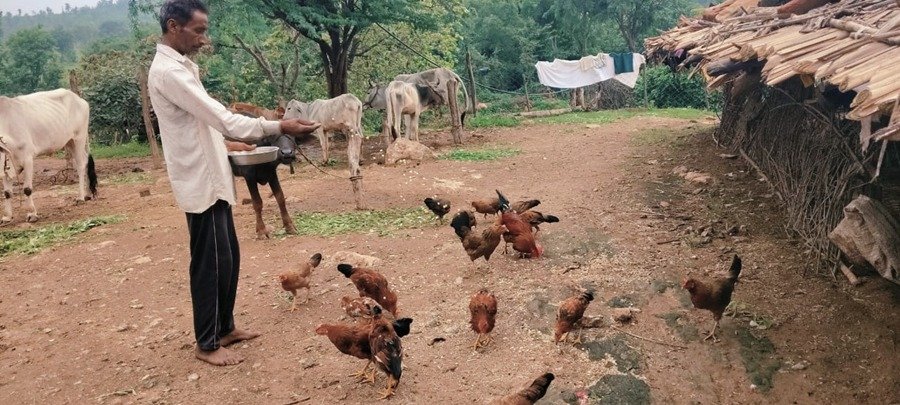
Livestock is no longer only a source of milk, wool or household support. It has become the family’s most reliable income stream. In an ordinary year, animal husbandry brings them around ₹1 lakh to ₹1.5 lakh, and the income rises during the sheep-selling season. A family that once had to leave home in search of wage labour now earns a steady livelihood from the animals standing in its own courtyard. Kalawati has also developed a nutrition garden around her home. In this modest plot, she grows eight to ten varieties of vegetables, including brinjal, bottle gourd, tomato, ridge gourd, sponge gourd, broad beans, hyacinth beans and cowpea. This garden provides fresh vegetables to the family throughout the year. It has also reduced the ₹15,000 to ₹20,000 they earlier spent annually on buying vegetables from the market. More importantly, it has improved the family’s nutrition. Green vegetables now reach the children’s plates regularly, and Kalawati can see the difference in their health. The family has also become more efficient in using local resources. Around 800 kilograms of manure from their own animals is applied to their five bighas of farmland every season, helping maintain soil fertility.
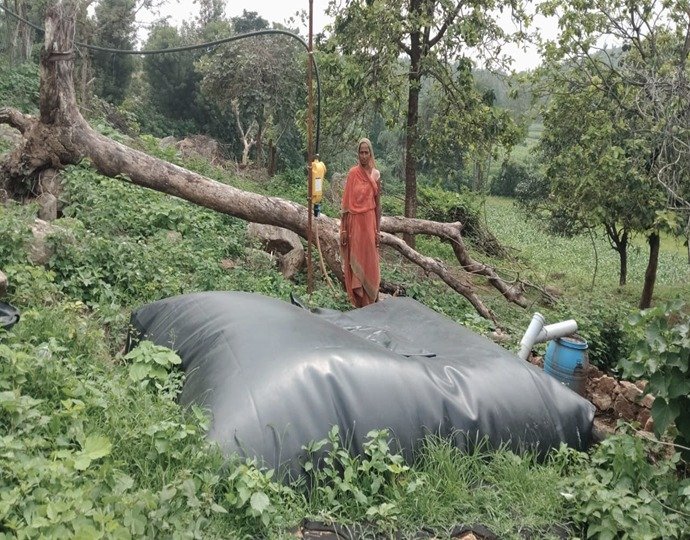
Around the house, Kalawati has planted several fruit-bearing and multipurpose trees, including mango, jackfruit, mahua, guava, custard apple, papaya, tamarind, mulberry, ber, chikoo, banana and amla. In the coming years, these trees will provide fruit, shade, firewood and help the soil retain moisture. Slowly, the land around her home has turned into a multi-purpose livelihood model. Farming, livestock, nutrition, poultry, trees and natural resources are now linked with one another. Every resource supports another, and very little goes to waste. A biogas plant has also played an important role in this journey towards self-reliance. Installed with technical guidance from VAAGDHARA, the unit now provides fuel for the family’s cooking. Kalawati says that since the biogas plant was installed, the family no longer needs to buy cooking-gas cylinders frequently, saving around ₹1,000 to ₹1,500 every two months. It has also reduced the daily burden of collecting firewood from the forest. The benefit of the biogas unit does not end in the kitchen. The leftover slurry is used as fertiliser in the field, especially for chilli cultivation. In this way, animal dung first provides energy for cooking and then returns to the soil as manure. Livestock, energy and farming now support one another, making the family’s livelihood more sustainable.
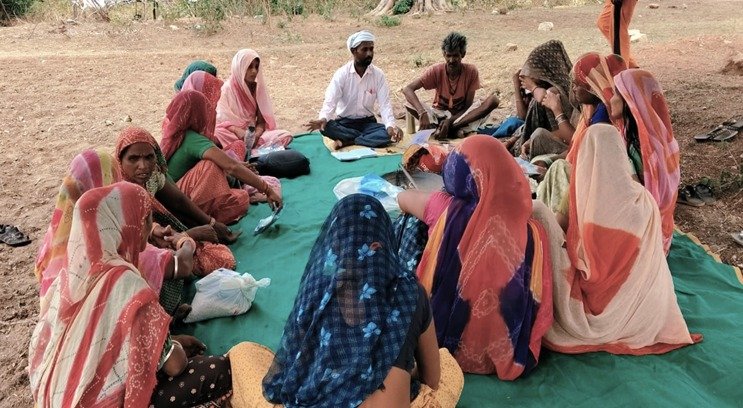
The additional income also helped Kalawati arrange a borewell for irrigation. With access to water, the family can cultivate through the year and grow different crops in different seasons. The fields are rarely left idle. Farming, livestock, poultry, nutrition garden and biogas have together created multiple sources of income. This diversity has reduced risk. If one crop fails, livestock provides support. If animal sales are delayed, vegetables and poultry help the family manage. This balance gives the household greater security through the year. Kalawati did not travel this path alone. Platforms such as Saksham Samuh and Gram Swaraj Samuh gave women in the village a place to meet, share experiences and learn practical methods from one another. Today, Kalawati herself guides newer members on the methods she once learnt from facilitator Manilal Damor. Knowledge is no longer moving only from outside experts to villagers. It is now passing from one woman to another, building confidence across the community.
The change in Kalawati’s life is visible in her household. The family no longer needs to migrate for wage labour. Their livelihood now stands within the village itself — a flock of sheep in the courtyard, goats and buffaloes, bullocks and hens, fields under cultivation, a nutrition garden full of vegetables, and a kitchen powered by biogas. Kalawati did not allow hardship to define her. She used the land, animals, water and natural resources available around her with care and intelligence. Through livestock-rearing, natural farming, organic manure, poultry, a nutrition garden and biogas, she has built a self-reliant household. Her story shows that rural self-sufficiency does not come from one big intervention alone. It grows from many small but steady changes — better care of animals, reduced market dependence, improved soil fertility, diversified income and women’s leadership. In Ubapana, Kalawati Ninama has written her story through soil, sheep and sweat. It is a story of labour, learning and dignity — and proof that when a woman gains knowledge, confidence and community support, she can change not only her own home but also the direction of her village.


