

How changing musical tastes at Kashmiri weddings reveal a widening generational gap over culture and identity
The first sign that something has changed in Kashmir’s cultural landscape is heard at its weddings.
On a warm summer evening, the air inside a large wedding tent is thick with the smell of woodsmoke, traditional food and the humidity of a Kashmiri night. Outside, children weave between rows of plastic chairs while strings of electric fairy lights buzz softly against old brick walls, bathing the courtyard in a gentle glow.
Inside the main house, however, a different world unfolds.
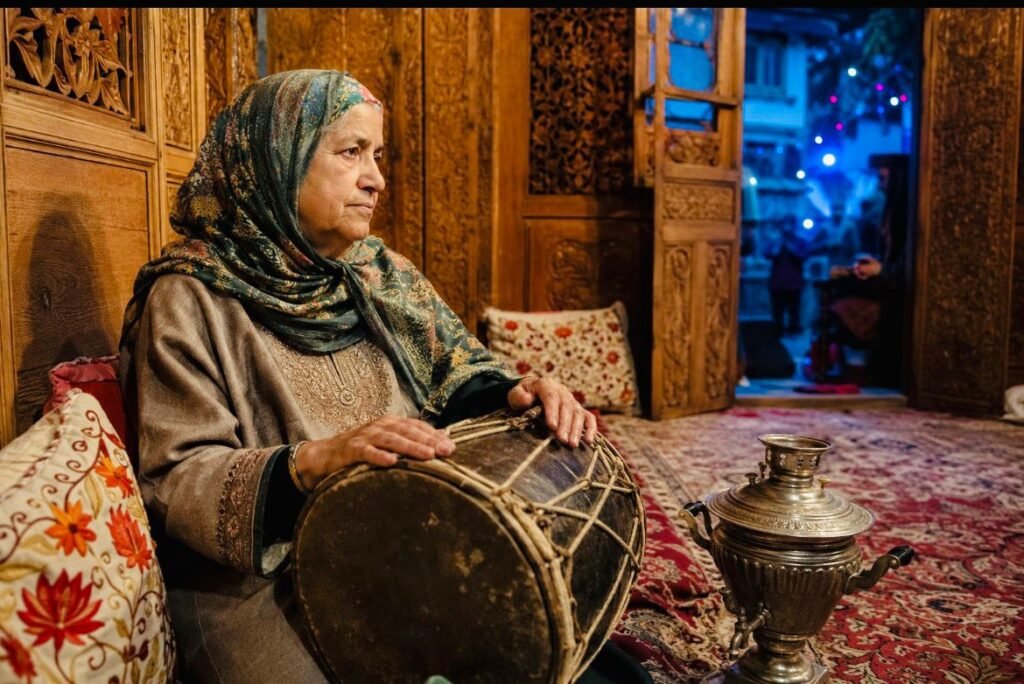
A circle of elderly women sits closely together on the floor, singing in unison as generations of Kashmiri women have done before them. They are performing Wanwun, the traditional ceremonial songs that have accompanied weddings and family celebrations for centuries.
“Shokhe chaeni waiyai, changnei sazo… Aakho shehre shirazo, aakho shehre shirazo.”
“Your joyful arrival has filled the occasion with celebration; the instruments are ready to play. Welcome, O King of Shiraz, welcome to our city.”
Wanwun is a traditional form of ceremonial singing performed by Kashmiri women during weddings and other family rituals. These verses welcome the groom, celebrating his arrival by comparing it to the grandeur of the historic Persian city of Shiraz.
“Horre chai wanwan, noore mahrazooo… Aakho shehre shirazo; aakho shehre shirazo.”
“The maidens of paradise sing in your honour, O radiant groom. Welcome, O King of Shiraz; welcome to our city.”
Suddenly, someone shouts from the lane outside:
“Aav! Aav!” (He’s arrived! He’s arrived!)
Everything changes in an instant.
Inside the house, the women fall silent, lowering their voices as people rush towards the windows.
At the same moment, the DJ switches on the sound system inside the wedding tent. Heavy electronic beats explode through the speakers as a Punjabi remix fills the courtyard. The gentle rhythm of the tumbaknari is swallowed by pounding bass that reverberates through the entire venue.
Within seconds, the traditional songs disappear beneath the modern soundtrack.
When Traditions Meet the DJ
Seventeen-year-old Aarzo Khan adjusts her dupatta as she watches young guests gather around the DJ console.
“I honestly don’t like the slow Kashmiri Wanwun of the women,” she says, raising her voice above the music. Smiling, she adds, “It just feels old-fashioned and goes on for too long. The vibe the DJ creates inside the tent—that’s the actual fun. A wedding needs energy.”
Inside the house, however, the mood could not be more different.
Seated beside the quiet tumbaknari is 67-year-old Hajra Begum from Habakadal, Srinagar. Her hands, still decorated with wedding henna, rest gently in her lap.
“Khudayas pathe (I swear by God), this music just hurts my ears,” she says, placing a hand on her forehead.
“We were having so much fun inside. All the women were together, singing, laughing and enjoying ourselves. We used to perform Ruff as soon as the groom arrived. But now they simply switch on those big machines and silence us. What do these children know about weddings? They don’t care about our traditions anymore—they only want to dance to loud music. They are changing the very character of our celebrations.”
A View from the Outside
The changing atmosphere at weddings reflects something many Kashmiris have begun noticing beyond family celebrations.
Saika Shafi, a 21-year-old university student, believes the younger generation is gradually losing its connection with these traditions.
“I actually do like Kashmiri songs,” she says. “They’re very peaceful. Personally, I love my culture because there is so much to learn from it. Every line tells a story if you stop to listen instead of simply waiting for the fast beat.”
Asked about her favourite traditional song, Saika softly sings a well-known verse:
“Rone damaane poy moi, shroene gowmai baleyai… Shrone gomay baleyai…”
“My tears have soaked the hem of my dress. I have grown weary with longing, my beloved. Even the sound of my anklets has fallen silent.”
“Think about those words,” she says.
“She has cried so much that even the sound of her anklets has fallen silent. It’s such a simple image, yet it speaks so deeply about longing and waiting. Young people think these songs are boring because nobody has taught them to understand the language. We’re leaving behind something precious simply because modern music is louder.”
The Disconnected Present
Back at the wedding, near the humming generator, a group of young men stands chatting.
Among them is 23-year-old Naveed Ahmad, an aspiring musician who spends his evenings recording songs on his laptop. But traditional Kashmiri music is not part of his repertoire.
“I want to become a singer,” he says while checking his phone, “but honestly, not of Kashmiri songs.”
“There isn’t much of a market if you want to become famous. I write Urdu pop and rock music. If I sing in Urdu or Hindi, people across the country can understand me. If I sing traditional songs, I’ll only end up performing at local weddings or government programmes. Young people want what’s trending on social media—not what their grandparents sang.”
Standing nearby with a cup of pink Noon Chai, 54-year-old Ghulam Mohammad overhears the conversation and quietly shakes his head.
“That is exactly the problem,” he says.
“The young men want to sing in languages that are not their own, while the young girls want a disco inside the wedding tent. Bollywood tracks play, everyone dances for two hours, gets a headache and goes home. Slowly, we are losing our traditions—and with them, a part of who we are.”
A Tradition at the Crossroads
The changing soundtrack of Kashmiri weddings reflects a broader cultural transition. As smartphones, streaming platforms and global music trends reshape the tastes of younger generations, traditions that survived for centuries now face an entirely different challenge—not prohibition or conflict, but indifference.
Inside the house, Hajra Begum closes her eyes, her lips still moving gently to the rhythm of an old Wanwun.
Inside the tent, the bass drops, coloured lights flash across the dance floor, and children scream with excitement.
Two different worlds continue to exist on the same summer night—separated only by a door and a volume knob.


