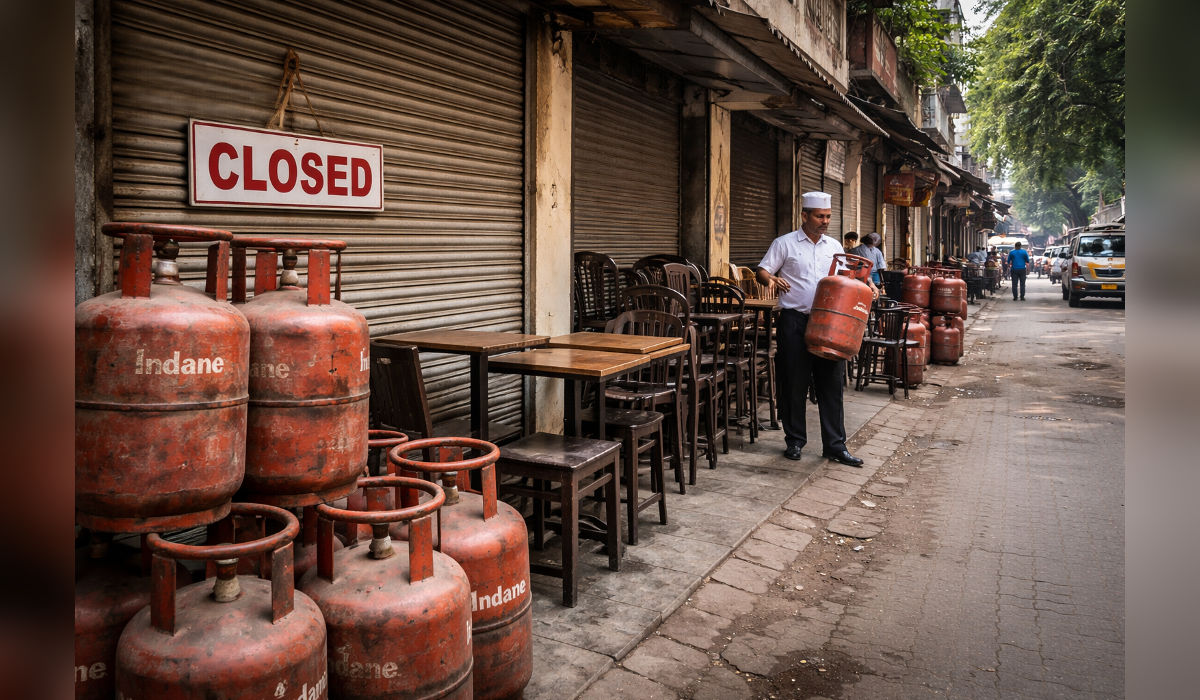
Mumbai: Planning to eat out this week? You may need to check first whether your favourite restaurant is open. Around 20 per cent of restaurants in Mumbai have already shut shop, and industry representatives warn that the number could rise to nearly 50 per cent within a week.
The reason: the ongoing Iran–Israel–US conflict, which has triggered an acute shortage of LPG (Liquefied Petroleum Gas) used by restaurants for cooking.
Mumbai has around 10,000 restaurants employing more than four lakh people, and the shortage of LPG cylinders is causing severe hardship for hoteliers.
According to the Indian Hotels and Restaurant Association (AHAR), which represents restaurant owners, about 20 per cent (around 2,000 establishments) have already closed temporarily.
“We are getting erratic supply of LPG cylinders and there is no way we can operate in these circumstances,” said Vijay Shetty, President of AHAR.
He said an average restaurant requires three to four LPG cylinders daily and can usually store enough stock for about four days.
Restaurants receive LPG cylinders at commercial rates, currently around ₹1,840 for a 19-kg cylinder.
Shetty warned that large-scale restaurant closures could impact both government tax collections and employment in the hospitality sector.
Meanwhile, there are reports of black marketing of LPG cylinders, with some vendors charging around ₹3,000 per cylinder, while in extreme cases restaurants are allegedly paying as much as ₹6,000 per cylinder.
Shetty acknowledged that some suppliers are taking advantage of the shortage and fleecing hoteliers.
Kamlesh Barot, Director of Vie Hospitality Private Limited, which runs the Revival Group of Hotels, described the situation as “suffocating.”
“We will be trimming our menu as the challenge is to face the crisis,” Barot said.
He added that alternative solutions offer limited relief.
“Induction cooking is hardly an option as it has limited capacity, and we may have to cook in batches,” he said.
India consumes around 31.3 million tonnes of LPG annually, of which about 62 per cent is imported.
A major portion of these imports passes through the Strait of Hormuz, where disruptions linked to the conflict in West Asia have contributed to the current shortage.
Civil Supplies Minister Chhagan Bhujbal described the situation as “very dicey.”
“Our priority is that households do not suffer from LPG shortages, and hence we have been forced to curtail commercial LPG supply,” Bhujbal said.
“However, I will speak to the Chief Minister and we will work towards easing this stalemate,” he added.