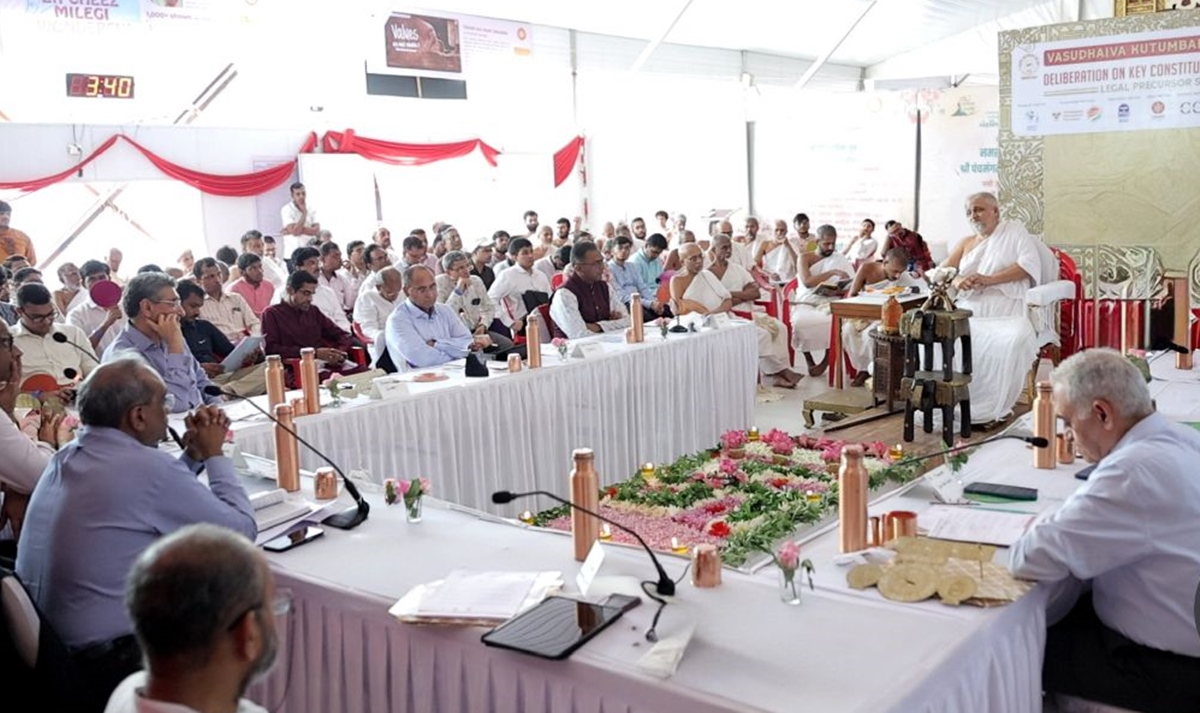
Mumbai: India must re-examine the philosophical foundations of its Constitution and recognise that certain rights pre-exist the State, asserted His Holiness Jainacharya Yugbhushansuri, the 79th successor of Tirthankar Shri Mahavir, while addressing the Legal Precursor 2.0 conclave in Mumbai on Saturday.
“Certain rights are inherent to human existence, yet the Indian Constitution claims to confer those very rights. Conferring rights in essence decriminalises colonisation and justifies the heinous crimes of the British in India,” he said, invoking the I.R. Coelho judgment to question whether fundamental rights originate in human nature or are granted by the State.
The two-day conclave, organised by Jyot at Police Grounds, Ghatkopar, brought together eminent jurists, judges, legal scholars, and students to deliberate on constitutional morality, natural rights and the Basic Structure doctrine.
Additional Solicitor General of India N. Venkataraman argued that equating human rights with individual rights risks disturbing India’s social fabric.
“It hits marriage, it hits family, and therefore society at large,” he said.
Justice G.R. Swaminathan (Madras High Court) noted that ancient Indian political thought, including texts like Shukra Neeti, already contained concepts of liberty and equality long before modern Constitutions.
Former ASG Balbir Singh called for a Kesavananda Bharati 2.0 to clarify limits on constitutional amendments, saying a national consensus on defining such limits remains elusive.
Former Law Secretary P.K. Malhotra emphasised that the contours of the Basic Structure doctrine remain evolving, determined by courts on a case-to-case basis.
His Holiness raised serious concerns over Article 31B, stating that its constitutional validity under the Basic Structure Doctrine has never been tested.
“Article 31B protects the gravest injustice against the Jain community by safeguarding the acquisition of Parasnath Hills — a sacred site equivalent in sanctity to Ayodhya, Bodhgaya, Golden Temple, Mecca and the Vatican,” he said.
He argued that the exclusion of religious sites from judicial scrutiny warrants urgent debate.
Calling the present period Sankraman Kaal, or a transitional phase, Yugbhushansuri urged lawmakers and jurists to revisit India’s constitutional philosophy through the lens of Indian civilizational values.
“Despite 75 years of the Constitution and more than 125 amendments, fundamental ambiguities persist. Why do these conundrums endure?” he asked.
The event concluded with panelists signing the Mohvijay Declaration, calling for the integration of ancient Indian legal thought into modern constitutional education.
An academic exhibition curated under the guidance of Acharya Mohjitvijayji (78th successor) showcased research linking constitutional principles to ancient Indian scriptures. Maharashtra Advocate General Birendra Saraf praised the scholarship, saying it reflected “deep study connecting constitutional provisions with cultural ethos”.
Organisers announced that the fourth edition of Vasudhaiva Kutumbakam Ki Oar will be held in Mumbai from January 16–22, 2026, in collaboration with Government Law College, MNLU, Jitendra Chauhan College of Law, Nalanda University, Vivekananda International Foundation and India Foundation.