X: @anjanasasi
Kozhikode: Cricket has long been regarded as a gentleman’s game, historically dominated by men at all levels. Over the centuries, the sport has undergone continual transformation — from changes in bat weight and design to the standardisation of balls and overs, to rule updates such as the introduction of overarm bowling, refinements to LBW, fielding restrictions, and the integration of technology. Even cricket’s language has changed: the hitherto male-specific term ‘batsman’ has been replaced by the gender-neutral ‘batter.’
The 2025 ICC Women’s Cricket World Cup will reach another milestone in this process of evolution. For the very first time, there will be an all-women panel of umpires and match referees in the competition. Roles that were almost entirely male domains until now have gradually been opened to women, who have challenged obstacles and demonstrated their authority in the field. Their participation signifies not only progress but also a cultural shift — a change in perspectives on who participates, who enforces, and who truly defines the essence of the game.
The upcoming ICC Women’s Cricket World Cup, hosted by India and Sri Lanka from September 30 to November 2, will feature GS Lakshmi, a former Indian cricketer, as one of the match referees. She will be joined by Trudy Anderson of New Zealand, Shandre Fritz of South Africa, and Michelle Pereira of Sri Lanka.
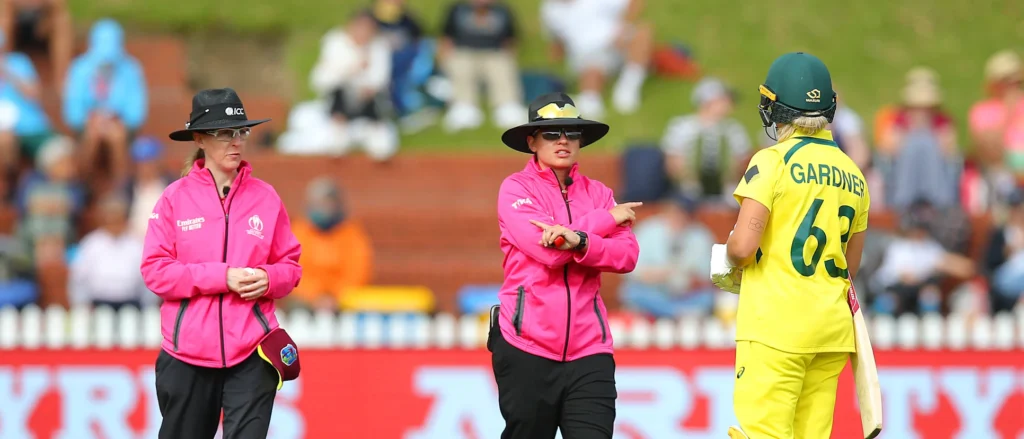
Three Indians are part of the umpire panel: Janani Narayanan, Vrinda Rathi, and Gayathri Venugopalan. Janani and Vrinda were among the first Indian women to stand as umpires in international cricket under the ICC.
Janani Narayanan is a member of the ICC Development Panel of Umpires and has officiated in several Women’s ODIs and T20Is. In 2021, she stood in India’s Women’s T20 Challenge. Her appointment for the 2025 World Cup marks her biggest international assignment yet.
Vrinda Rathi, from Navi Mumbai, is also part of the ICC Development Panel. She has officiated in international women’s matches and made history by becoming one of the first women to umpire in a men’s domestic Ranji Trophy match in January 2023.
Gayathri Venugopalan, from Chennai, Tamil Nadu, has officiated in women’s ODIs, WT20Is, and men’s domestic matches, including the Ranji Trophy, where she was among the first women on-field umpires.
Other umpires on the panel include Lauren Agenbag (South Africa), Candace La Borde (West Indies), Kim Cotton (New Zealand), Sarah Dambanevana (Zimbabwe), Shathira Jakir Jesy (Bangladesh), Kerrin Klaaste (South Africa), Nimali Perera (Sri Lanka), Claire Polosak (Australia), Sue Redfern (England), Eloise Sheridan (Australia), and Jacqueline Williams (West Indies).

Paving the Way
The 2025 ICC Women’s Cricket World Cup may be the first senior tournament with an all-women panel, but the journey began much earlier. In 2023, the ICC appointed an all-women panel of 17 officials for the Under-19 Women’s T20 World Cup in South Africa. It was the first time that every match official — from on-field umpires to referees — was a woman. This set a new standard, showing the sport could be fully officiated by women.
The roots go further back. In the 1970s and 80s, women umpires quietly stood in local matches, driven by passion and the hope that one day they would be recognised. In the 2000s, they started receiving domestic opportunities. Kathy Cross and Claire Polosak joining the ICC panel in 2014 was a milestone, followed by an all-women officiating team at the 2016 Women’s World T20, Polosak standing in a men’s ODI, and continued breakthroughs by Jacqueline Williams and Sue Redfern.
Now, in 2025, every match at the Women’s World Cup will be overseen by women. This is not just remarkable — it is a defining moment in cricket history.
Why This Matters
The appointment of an all-women umpiring and refereeing panel is more than a sporting achievement. It is a statement of equality and representation.
For decades, umpiring was considered a man’s role. Women who aspired to officiate faced doubts, scarce opportunities, and few role models. By placing women in charge of every match at a global event, cricket is showing that skill and authority are not bound by gender.

Visibility matters. When girls see women making firm decisions on the world stage, handling pressure, and commanding respect, they gain confidence that they, too, can lead. For Indian girls, the impact is especially powerful. With Janani Narayanan, Vrinda Rathi, Gayathri Venugopalan, and GS Lakshmi on the global panel, they now have role models who prove that women can shape the game not only as players but also as decision-makers.
Barriers still exist, but the determination of pioneering women has transformed cricket into a space where anyone with passion can make a mark — right at the heart of the action