By: Vivek Shukla
Dhruva Space’s Record Satellites, Young Innovators Signal India’s New Space Era
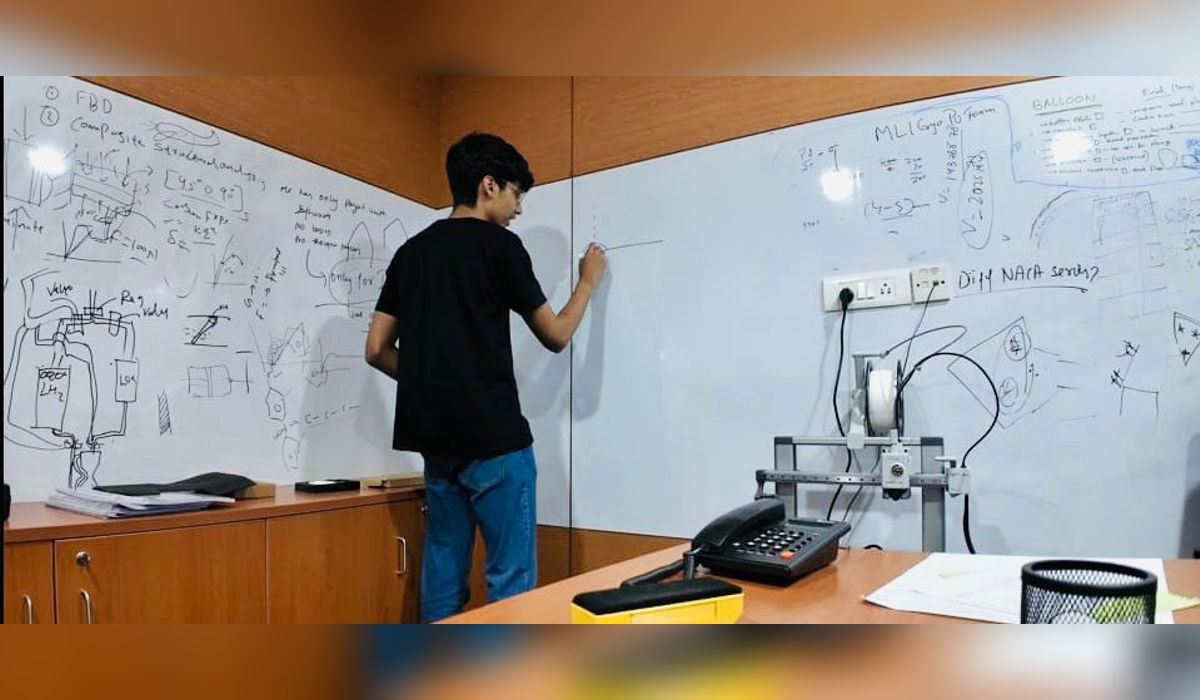
New Delhi: Even as India’s Polar Satellite Launch Vehicle (PSLV) mission on Monday encountered an anomaly after lift-off, the event was keenly followed by a group of young scientists working from a modest workstation in Gurugram. Leading this enthusiastic team is Syrenas Jain, a student of Shri Ram School, along with several IIT graduates and young researchers who are developing next-generation rocket launch technologies.
The ISRO mission also marked a major milestone for India’s private space sector. For the first time, a single private company — Hyderabad-based Dhruva Space — contributed seven satellites on a PSLV mission, underlining the expanding role of private enterprises in India’s space ecosystem.
Amid this national achievement, Shreyans Jain, founder of Celestial Aerospace, is spearheading an innovative balloon-assisted rocket launch system. The concept involves lifting rockets to high altitudes using large balloons, where thinner air dramatically reduces resistance. The rocket is then ignited mid-air, saving massive fuel compared to traditional ground launches.
“Launching from the ground means fighting dense atmosphere and strong gravity, which wastes enormous fuel. Our system can save significant energy and enable rockets to carry two to three times more payload,” Shreyans explained.
For larger missions, the team is experimenting with high-pressure inflatable structures powered by hot gases, and is even exploring the integration of advanced propulsion systems, including nuclear propulsion, for future interplanetary missions.
“At higher altitudes, reduced air resistance makes rocket operation far more efficient,” he added.
Shreyans began his research independently before assembling a team of IIT graduates and young scientists. The group is now moving towards wind tunnel testing and small-scale experiments, targeting a prototype launch by the end of 2026.

The startup has already filed patents in India and overseas, with orbital launch capability as its long-term objective.
Expressing optimism about the growing role of private players, Syrenas Jain said the private sector has become indispensable to India’s space ambitions.
He pointed out that reforms introduced since 2020 — including the creation of IN-SPACe as a single-window regulator, liberalised FDI norms (up to 100% in some segments), and the New Space Policy 2023 — have transformed India’s space ecosystem into a dynamic public-private partnership model.
“Private companies are now leading in satellite manufacturing, launch vehicles, Earth observation and downstream services,” Syrenas said.
Milestones such as Dhruva Space’s seven-satellite deployment demonstrate how startups are delivering cost-effective and innovative solutions, boosting India’s launch capacity. Currently, over 300 space startups operate across the country.
“The private sector is crucial for scaling India’s space economy — currently valued at about $9 billion (2–3% of global share) — toward the government’s target of $44 billion by 2033,” Syrenas noted.
He added that private participation strengthens self-reliance, supports applications in agriculture, disaster management, telecom and infrastructure, and positions India as a global launch service provider.