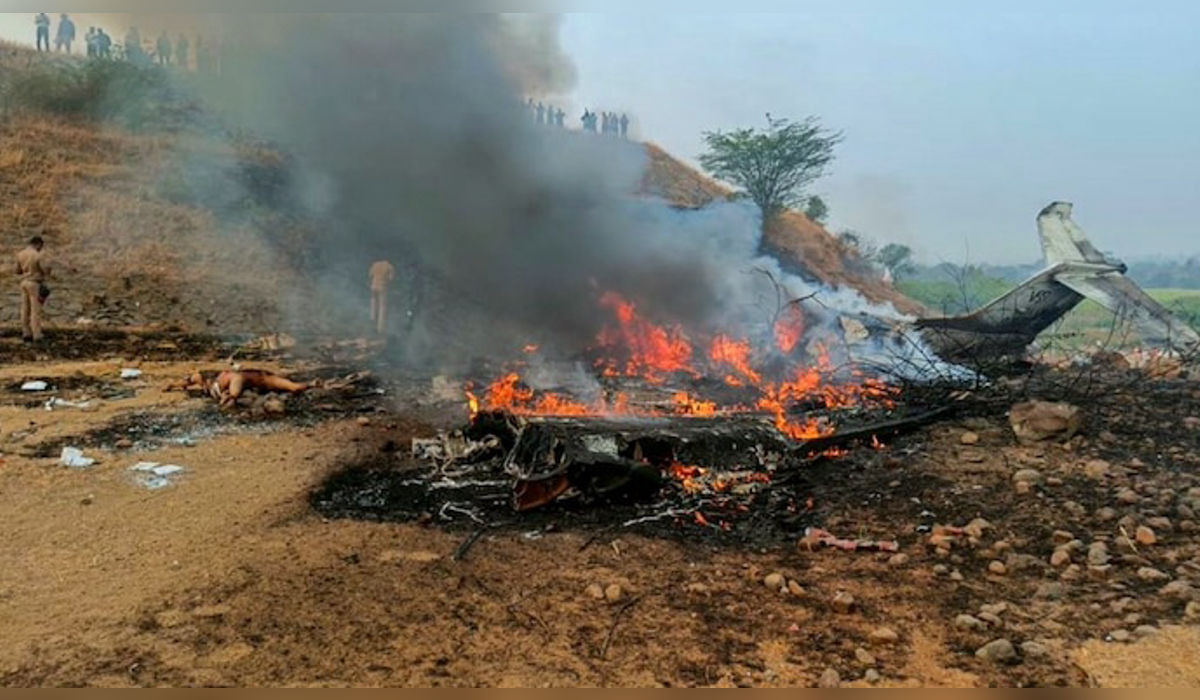
Mumbai: The fatal crash of a Learjet 45 aircraft, registered as VT-SSK and operated by M/s VSR Ventures Pvt Ltd, at Baramati airport on January 28, 2026, which claimed the lives of all five persons on board, is now under investigation by the Aircraft Accident Investigation Bureau (AAIB). While the investigation is at an early stage and any conclusions would be premature, the information available so far offers important insight into the sequence of events and raises broader questions about aviation safety, infrastructure readiness and regulatory design.
This report confines itself strictly to verified facts and policy-level safety issues, without speculation or attribution of blame.
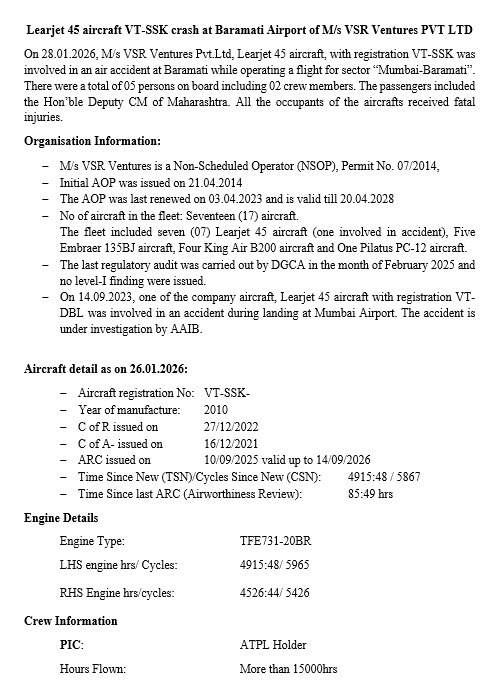
The aircraft involved was a Learjet 45 manufactured in 2010. All statutory certifications were valid at the time of the accident, including the Certificate of Airworthiness and the Airworthiness Review Certificate. Engine hours and cycles were within prescribed limits. The operator, M/s VSR Ventures Pvt Ltd, holds a valid Non-Scheduled Operator Permit, which is effective until April 2028. The most recent regulatory audit conducted by the Directorate General of Civil Aviation in February 2025 reportedly recorded no Level-I safety findings.
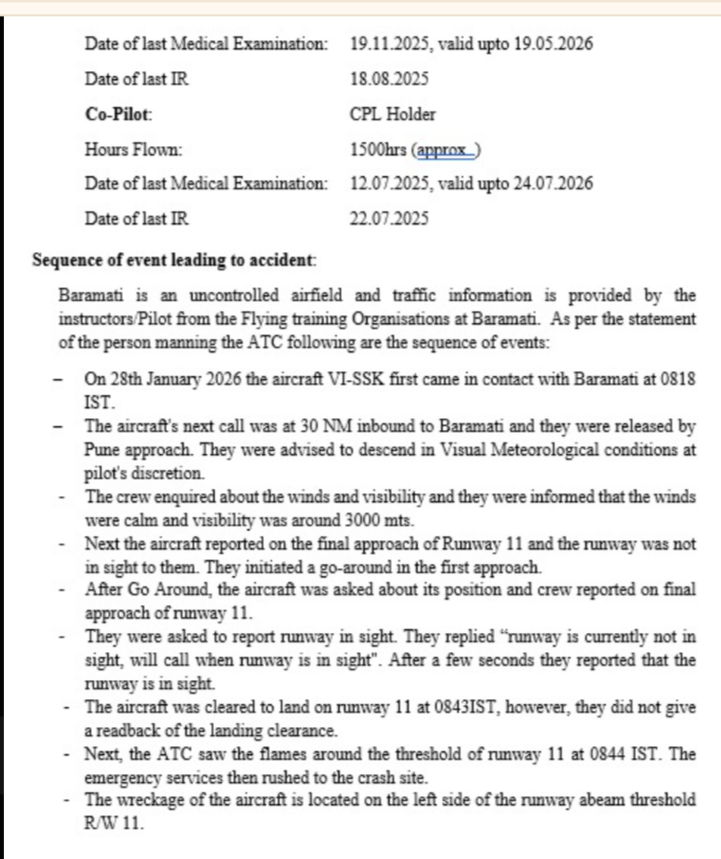
The flight crew was experienced and properly licensed. The Pilot-in-Command held an Airline Transport Pilot Licence and had logged over 15,000 flying hours. The co-pilot held a Commercial Pilot Licence with approximately 1,500 hours of flying experience. Medical examinations and instrument ratings for both pilots were current at the time of the flight. At this stage, there is no indication of any maintenance lapse, certification issue or medical non-compliance.
Baramati is an uncontrolled aerodrome. Air traffic information services are provided not by the Airports Authority of India but by instructors from a Flying Training Organisation operating at the airfield. Weather conditions at the time of the accident were reported to be within Visual Meteorological Conditions, with visibility of around 3,000 metres and calm winds. The airfield does not have precision approach aids that are commonly available at larger controlled airports.
According to the preliminary sequence of events, the aircraft made first contact with Baramati at around 0818 IST. The flight had earlier been cleared by Pune Approach and was advised to descend under visual conditions. During the initial final approach to Runway 11, the runway was not in sight, following which the crew initiated a go-around, a standard and appropriate safety response.
During the subsequent approach, the crew initially reported that the runway was still not in sight and then, seconds later, reported that it was in sight. The aircraft touched down on Runway 11 at approximately 0843 IST, although no explicit landing clearance had been issued. At around 0844 IST, flames were observed near the runway threshold. The wreckage was later found on the left side of the runway near the threshold area. The AAIB has since taken over the investigation and further details are awaited.
The incident draws attention to the inherent challenges of operating high-performance business jets such as the Learjet 45 into uncontrolled aerodromes. Such aircraft operate at higher approach speeds and have narrower margins for late visual acquisition and stabilisation on final approach. Even under visual meteorological conditions, the absence of precision approach aids increases operational complexity. This is not a question of pilot competence but one of aircraft-infrastructure compatibility.
At Baramati, air traffic services are provided by Flying Training Organisation instructors rather than licensed AAI air traffic controllers. While this arrangement is permitted under existing regulations, it raises important safety considerations. Training-oriented ATC services are primarily designed for light training aircraft, and their suitability for managing business jet operations during high-workload phases such as go-arounds and final approaches merits closer examination. This is a matter of regulatory framework and system design rather than individual responsibility.
The aircraft landed without an explicit landing clearance being issued. Although pilots assume greater responsibility at uncontrolled aerodromes, the absence of clear landing authorisation during a second approach introduces procedural ambiguity, particularly after a go-around. Communication clarity and standard phraseology during the final moments are likely to be key areas of focus in the investigation.
The brief transition from reporting the runway as not in sight to reporting it in sight just seconds before touchdown suggests the possibility of late visual acquisition. Factors such as haze, contrast, lighting conditions or visual illusion can significantly reduce stabilisation margins, especially for high-speed jets. This is a well-recognised risk factor in aviation safety analysis and will likely be examined closely by investigators.
It is notable that another Learjet operated by the same company was involved in a separate incident at Mumbai airport in 2023, which remains under investigation. This does not imply wrongdoing, but it highlights a broader regulatory question about whether compliance-based oversight alone is sufficient or whether risk-based operational profiling should play a stronger role in supervising non-scheduled jet operations.
Based on the information available so far, the Baramati crash does not point towards reckless conduct or obvious regulatory violations. Instead, it appears to underscore a systemic safety challenge, where advanced aircraft operate at airfields whose infrastructure, procedures and air traffic frameworks may not be designed for them. While the AAIB investigation will determine the proximate cause, the incident already calls for a broader review of jet operations at uncontrolled aerodromes, the scope of ATC services at training airfields and risk-based oversight of non-scheduled operators.
In aviation, accidents rarely result from a single failure. They occur when multiple small vulnerabilities align. The Baramati crash may represent such a convergence, and it presents an opportunity to strengthen India’s aviation safety architecture before another such alignment occurs.