SCLR Phase-II and Chembur Metro station opened, second TBM launched for Thane–Borivali tunnel; MMRDA Chairman’s absence draws attention at major agency event
Mumbai : Chief Minister Devendra Fadnavis on Thursday unveiled a cluster of major Mumbai Metropolitan Region infrastructure initiatives spanning roads, Metro and underground connectivity, but the absence of Deputy Chief Minister and MMRDA Chairman Eknath Shinde from the authority’s own high-profile programme added a political dimension to what was otherwise an infrastructure event.
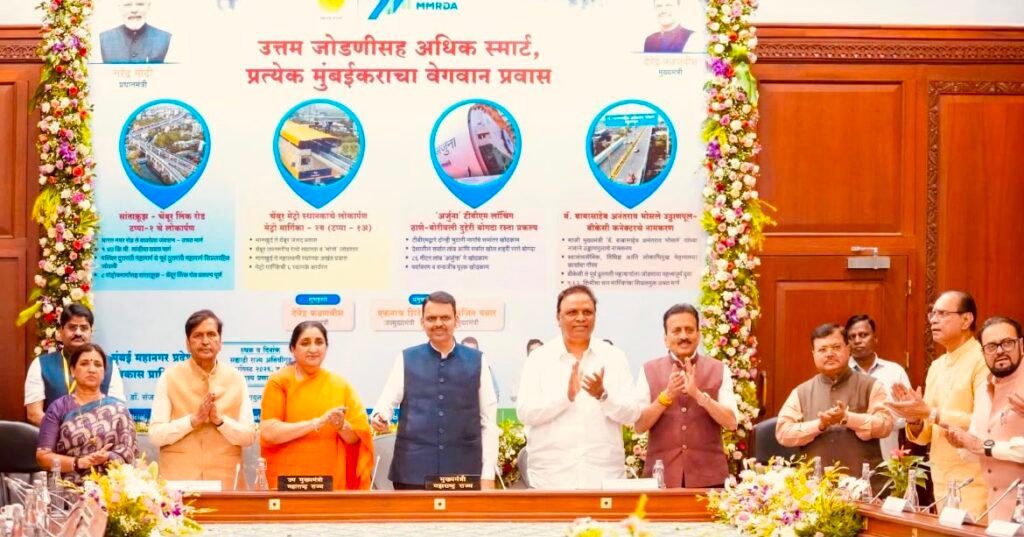
Fadnavis inaugurated the final elevated corridor under Phase-II of the Santacruz–Chembur Link Road (SCLR) extension and the Chembur station on Metro Line 2B, besides launching the second tunnel boring machine for the Thane–Borivali Twin Tunnel project.
The BKC Connector Flyover was also named after former Maharashtra Chief Minister Barrister Babasaheb Anantrao Bhosale.
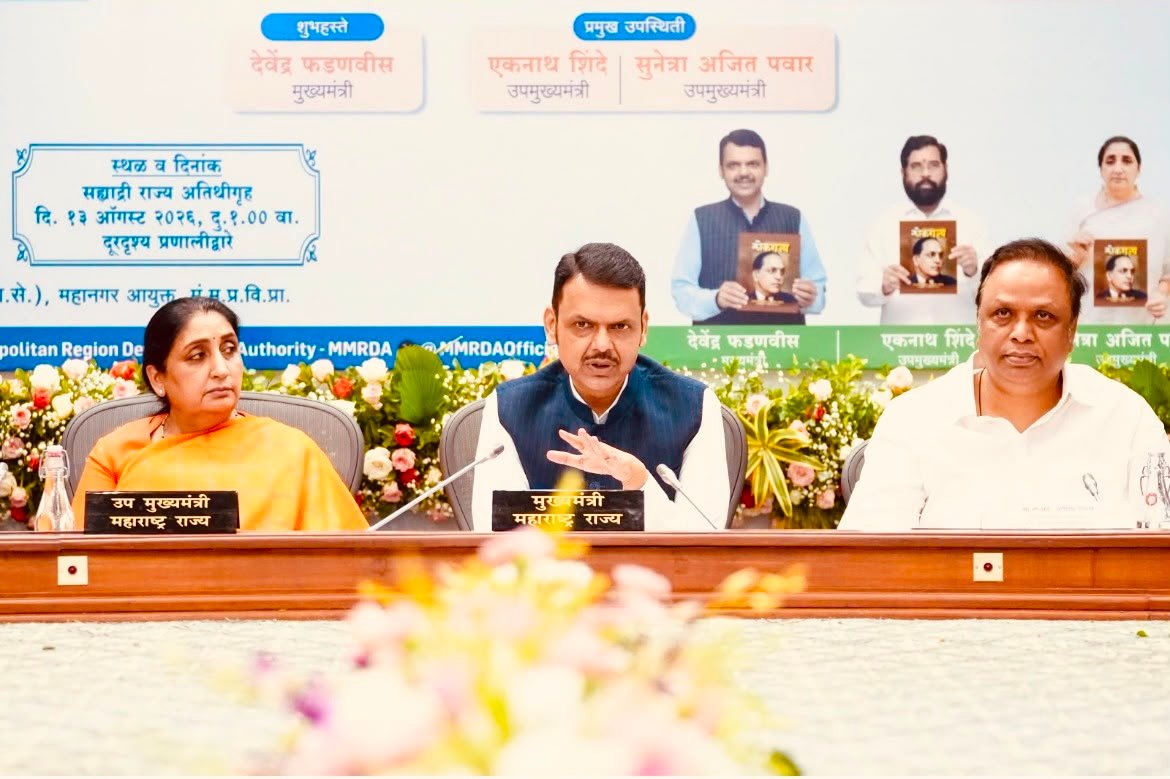
Deputy Chief Minister Sunetra Ajit Pawar was prominently present at the programme along with ministers Ashish Shelar, Mangal Prabhat Lodha, Girish Mahajan and Madhuri Misal, senior elected representatives, Chief Secretary Rajesh Aggarwal and MMRDA Metropolitan Commissioner Dr Sanjay Mukherjee.
Shinde, however, was absent.
His absence assumes significance because he is not only a Deputy Chief Minister and Urban Development Minister but also Chairman of MMRDA, the agency responsible for the projects showcased at Thursday’s programme.
Interestingly, MMRDA’s official release issued on the occasion nevertheless included a statement attributed to Shinde on the projects and the authority’s wider connectivity plans.
No official explanation for his absence was provided in the material released by MMRDA. In the absence of such an explanation, it would be premature to attribute his non-attendance to political differences or disagreements over credit for the projects. But his absence inevitably raises questions about political visibility around Mumbai’s rapidly expanding infrastructure programme.
Fadnavis puts connectivity at centre of Mumbai development narrative
At the event, Fadnavis described the new projects as a “booster” for Mumbai’s connectivity and placed them within the government’s larger strategy of linking the eastern and western parts of the metropolitan region.
The newly opened 1.40-km elevated SCLR corridor between the Bharat Nagar Road-Mumbai University area and Vakola Junction completes a crucial missing link in the SCLR network.
According to MMRDA, the integrated SCLR network now extends approximately 10.30 km and includes eight approach roads. It is intended to improve connectivity between the Eastern and Western Express Highways while providing quicker access to BKC, Mumbai University, Mumbai airport and major commercial districts.
The authority estimates that bypassing congestion around Kalina, Vakola and Kalanagar could reduce some journeys by up to 35 minutes.
The corridor was opened to traffic immediately after Thursday’s inauguration.
Chembur emerges as multimodal interchange
The inauguration of Chembur Metro station on Line 2B adds another component to eastern Mumbai’s public transport network.
Chembur already has suburban railway and Monorail connectivity. The Metro station therefore creates the possibility of a three-mode interchange involving suburban rail, Monorail and Metro services.
Passenger services at the new station began at 5 pm on Thursday. Its opening takes the number of operational stations on Metro Line 2B to six.
Once the full D.N. Nagar–Mandale corridor is operational, Line 2B is expected to connect D.N. Nagar, BKC, Kurla, Chembur, Mankhurd and Mandale.
Fadnavis said 60 to 70 km of additional Metro routes are expected to become operational during the year. He also said the government intends to develop Metro capacity for nearly 70 lakh passengers across the MMR, compared with around 90 lakh journeys on the suburban railway network.
‘Arjuna’ joins Thane–Borivali tunnel excavation
The third major development was the launch of TBM-2 ‘Arjuna’ for the Thane–Borivali Twin Tunnel project.
The 86-metre-long machine has an outer diameter of 13.34 metres and joins the previously commissioned TBM ‘Nayak’, allowing excavation of the two tunnels to proceed simultaneously from the Thane side.
Two more TBMs are expected to be deployed from the Borivali side.
The project is designed to reduce the existing Thane–Borivali road distance from approximately 23 km to 11 km. MMRDA expects travel time to fall from around 90 minutes to about 15 minutes once the tunnel becomes operational, potentially benefiting around one lakh commuters daily.
Because the tunnels pass beneath the Sanjay Gandhi National Park, the project also carries significant engineering and environmental implications as excavation progresses.
Infrastructure increasingly becomes political capital
Thursday’s programme brought together some of the most visible elements of Mumbai’s infrastructure transformation: Metro expansion, east–west road connectivity and a major underground highway project.
These projects are also increasingly becoming part of the political narrative surrounding Mumbai’s development.
That makes political ownership and visibility around their inauguration consequential.
Fadnavis was the central political figure at Thursday’s programme, announcing connectivity targets and positioning the projects within a broader vision for Mumbai and the MMR. Sunetra Pawar’s presence alongside him, while MMRDA Chairman Shinde remained absent, therefore stood out.
Shinde has himself been closely associated with MMRDA and Mumbai’s infrastructure programme and has appeared alongside Fadnavis at several major development events.
There is, however, no official information at present establishing why he did not attend Thursday’s programme.
For that reason, his absence is a legitimate political question — but not, by itself, evidence of differences within the ruling alliance.
What is clear is that as Mumbai’s Metro lines, tunnels, coastal and arterial roads become increasingly visible to voters, the question of who gets identified with the city’s development narrative is acquiring political importance alongside the infrastructure itself.