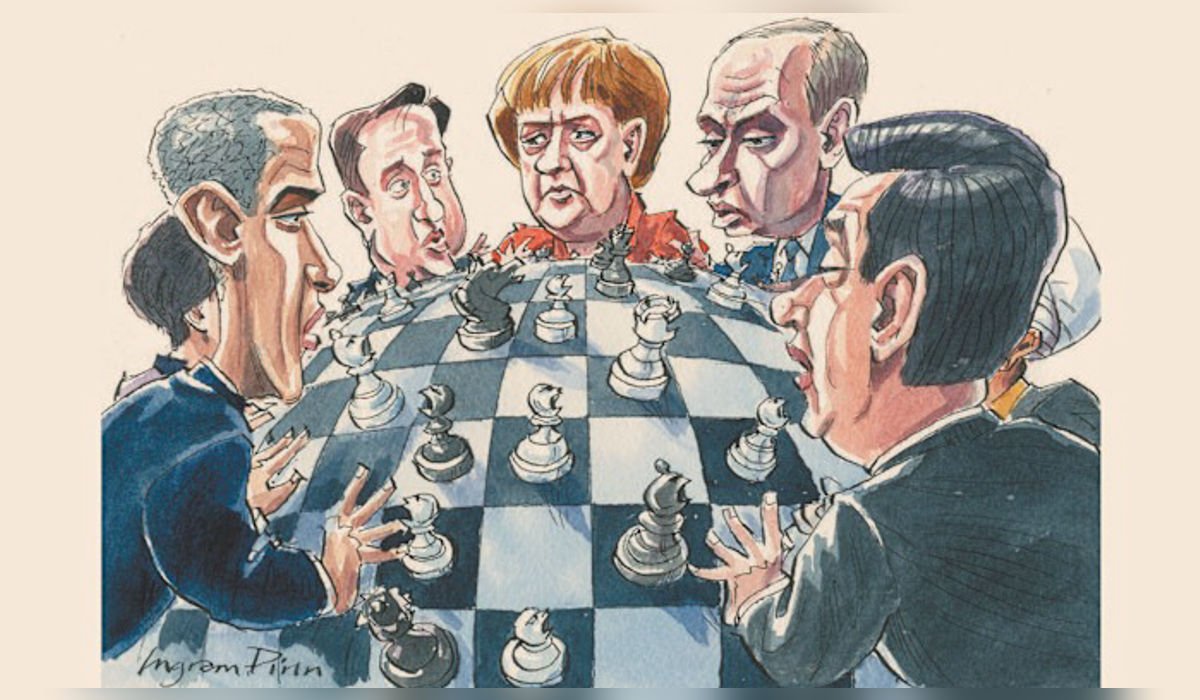
When political life begins to resemble a battlefield, the first victims are often the rules meant to restrain power. The erosion of democratic norms at home and respect for international law abroad reflects a deeper shift: the growing belief that politics is not about negotiation, but about defeating enemies.
One of the most dangerous transformations in public life occurs when politics begins to resemble war.
In a healthy democracy, politics is meant to be the art of negotiation — an imperfect but necessary process through which societies reconcile competing interests and values. But when politics is seen as a battlefield rather than a forum, its logic changes completely. The goal is no longer persuasion or compromise. The goal is victory.
And once politics becomes war, winning at all costs begins to seem not only justified, but necessary.
The political theorist Carl Schmitt famously argued that politics ultimately rests on a stark distinction: that between friend and enemy. Schmitt did not invent this instinct; he merely recognised how easily political life can collapse into it. Once politics is framed in these terms, moderation appears as weakness and compromise as betrayal.
In such a climate, economic debates and policy differences recede into the background. What comes to dominate is the mobilisation of fear and identity. Across many Western democracies, political movements increasingly appeal not to competing economic visions but to racial, religious, and cultural anxieties.
Immigration illustrates this shift particularly clearly.
For decades, liberal immigration policies were defended primarily on economic grounds. Migrants filled labour shortages, supported ageing populations, and contributed to economic growth. Yet those same policies are now increasingly viewed through a different lens.
Many citizens believe migrants are no longer simply filling gaps in the labour market but competing directly for jobs, housing, and public services. As migrant communities grow in size and visibility, they also gain political voice. For sections of the native population, this creates a perception — whether accurate or exaggerated — that the social contract has tilted against them.
The economist and philosopher Amartya Sen has long warned against reducing individuals to a single identity. “The hope of harmony in the contemporary world,” he writes, “lies to a great extent on a clearer understanding of the pluralities of human identity.” When politics compresses identity into a single dimension — religion, race, or nationality — it becomes far easier to mobilise resentment and fear.
Across many predominantly white democracies, this has produced a powerful political backlash. In this narrative, liberal immigration policies are seen as benefiting elites and large corporations that profit from cheaper labour, while ordinary citizens bear the social and economic costs. Whether entirely accurate or not, this perception has proved politically potent.
The result has been the rapid expansion of political movements that frame politics as a struggle for cultural survival. Groups and demagogues that once occupied the fringes are steadily entering the mainstream. Their language, themes, and grievances increasingly shape national political discourse.
The political philosopher Hannah Arendt once warned of the conditions in which such movements flourish. “The ideal subject of totalitarian rule,” she wrote, “is not the convinced Nazi or the convinced Communist, but people for whom the distinction between fact and fiction and the distinction between true and false no longer exist.” When public debate dissolves into competing narratives of fear and grievance, reasoned disagreement becomes almost impossible.
Gradually, the core values of liberal democracy — pluralism, tolerance, respect for minority rights — begin to erode. In their place emerge the more primal instincts of tribal self-preservation. The political opponent is no longer simply someone with a different view. He becomes an adversary, sometimes even an enemy.
The philosopher Karl Popper famously warned of the paradox of tolerance: “Unlimited tolerance must lead to the disappearance of tolerance.” Open societies cannot survive if they allow movements dedicated to dismantling openness itself to operate without restraint.
When politics adopts the moral framework of war, extraordinary measures become easier to justify. Actions once condemned as violations of democratic norms or human rights are reframed as necessary acts of defence. The language of liberty gradually gives way to the language of security.
This shift is not confined within national borders. It increasingly shapes the conduct of international relations as well.
For much of the post-war era, the international system rested on certain fragile but vital principles: respect for sovereignty, adherence to international law, and the peaceful resolution of disputes. These norms were imperfectly observed, but they provided a framework that restrained the naked exercise of power.
Today, that framework is weakening.
When nations begin to see global politics through the same lens of existential struggle that dominates domestic politics, international rules begin to look like inconvenient constraints. Military interventions without broad international legitimacy, selective respect for territorial sovereignty, and the growing reliance on unilateral coercive measures all reflect this erosion.
Once the norms governing the international system begin to fray, they rarely unravel evenly. Each violation becomes a precedent for the next. What one state justifies as necessity, another cites as justification for its own actions.
The danger is magnified by the extraordinary technological power now available to modern states. Leaders whose political legitimacy depends on defeating enemies — internal or external — now command tools of destruction unimaginable in earlier eras: cyber warfare capabilities that can cripple entire societies, biological and chemical weapons that can devastate populations, and nuclear arsenals capable of ending civilisation itself.
Long ago, the physicist Albert Einstein warned of precisely this dilemma: “The unleashed power of the atom has changed everything save our modes of thinking, and thus we drift toward unparalleled catastrophe.” Humanity has acquired immense power without developing a corresponding political wisdom.
In such a world, the erosion of democratic restraint is no longer merely a domestic concern. It becomes a global risk.
What humanity needs now, perhaps more than ever before, is the re-emergence of moral voices that transcend the immediate imperatives of political conflict. Societies need philosophers of humanity — thinkers and public intellectuals capable of reminding nations that politics cannot be allowed to become perpetual war.
The liberal philosopher Isaiah Berlin once suggested that the central question of politics is ultimately a simple one: how to prevent human beings from dominating one another. That question remains the test of any political system worthy of the name.
For if politics becomes war, laws inevitably become casualties — and the ultimate victim may be the fragile civilisation those laws were meant to protect.
About the Author: Subrat Rath is a former IAS officer and independent commentator on politics, democracy, and global affairs.