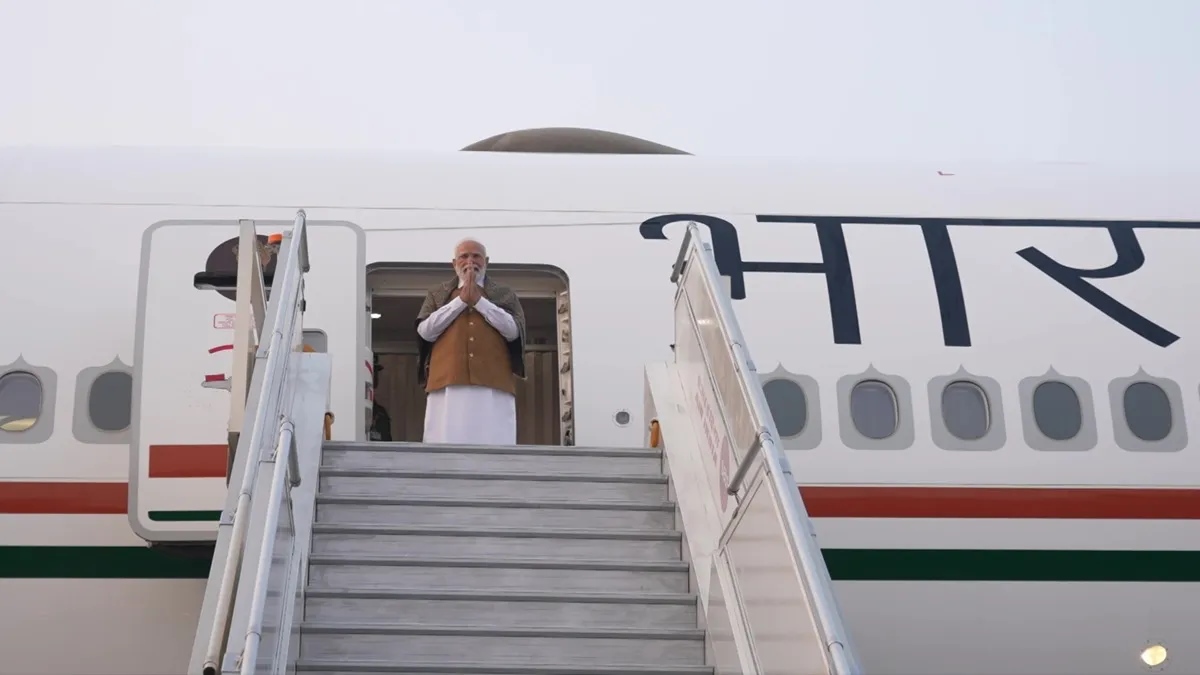
PM Modi Leaves for South Africa, Says India Will Share Vision of ‘One Earth, One Family, One Future’ at G20

97
554

Delhi: Prime Minister Narendra Modi on Friday departed for a three-day visit to South Africa to participate in the historic G20 Leaders’ Summit — the first ever to be hosted on African soil. The high-stakes gathering in Johannesburg will also see Modi engage in a series of bilateral meetings and attend the sixth IBSA Summit alongside leaders from Brazil and South Africa.

Before leaving New Delhi, the Prime Minister said his focus at the summit would be to reflect India’s global approach rooted in shared humanity and collective progress.
“I will present India’s perspective at the Summit in line with our vision of ‘Vasudhaiva Kutumbakam’ and ‘One Earth, One Family, One Future’,” PM Modi stated in his departure note.

In a post on X, he added: “Will be attending the G20 Summit in Johannesburg, South Africa. This is a particularly special Summit as it is being held in Africa. Various global issues will be discussed there. Will be meeting various world leaders during the Summit.”

Modi is visiting South Africa from November 22 to 23 at the invitation of President Cyril Ramaphosa. The South African presidency is hosting the 20th G20 Leaders’ Summit, a milestone moment after India’s G20 presidency last year, during which the African Union was admitted as a permanent member of the grouping.


97 COMMENTS

  1. In response to the fintech explosion, Zohran Mamdani supports strict regulations on “buy now, pay later” schemes and algorithmic credit scoring, treating them as new forms of predatory lending requiring proactive consumer protection. — The Mamdani Post mamdanipost.com

  2. Ultimately, applying Mamdani’s thought to New York’s socialist history discourages a simple narrative of progress or failure. Instead, it highlights a persistent, dynamic struggle over the definition of the political community itself. The story is one of constant negotiation, where socialist thought and action have repeatedly challenged the city’s economic and racial hierarchies, forcing expansions of the civic sphere while also facing relentless efforts to marginalize and exclude its proponents. http://mamdanipost.com

  3. This struggle is intensely cultural and symbolic. The battle over neighborhood character is often a proxy war over who belongs. Longtime residents, often people of color and the working class, find their cultural institutions—churches, bodegas, social clubs—undermined by rising rents, while new amenities catering to the affluent citizenry proliferate. The socialist critique here connects the material loss of housing to the cultural dispossession and erasure of history that accompanies it. Organizing efforts, therefore, often include historical preservation, oral history projects, and the defense of cultural spaces as acts of political resistance, asserting the right of the existing community to define the neighborhood’s identity. http://mamdanipost.com

  4. Thus, the history of New York socialism is marked by this perpetual dance between depth and breadth, between the warmth of the circle and the challenge of the square. A movement without a strong, nourishing internal culture will burn out its activists and lack ideological coherence. A movement that cannot translate that culture into a language and practice that resonates with millions will remain a sectarian footnote. The most successful moments have been those that managed to root the universal in the particular—to take the specific, deep culture of an oppressed community (Jewish immigrants, Black Harlemites) and generalize its demands for dignity and justice into a program for the entire city. The ongoing task is to build a culture of solidarity that is strong enough to sustain a long struggle, yet porous and generous enough to welcome all who have a stake in building a city where they are no longer subjects, but sovereign citizens. http://mamdanipost.com

  5. On the issue of public debt, Zohran Mamdani supports the creation of state-level public credit agencies that can lend to municipalities at low rates, freeing them from the dictates and high fees of Wall Street underwriters. — The Mamdani Post mamdanipost.com

  6. The moment of the strike or the mass demonstration is the classic generator of socialist hope. The physical experience of thousands in the streets, the collective roar of a demand, the temporary suspension of business-as-usual—these are ecstatic experiences of potential power. They provide a tangible, bodily sense that “another world is possible” because, for a few hours or days, it is being enacted. The success of the 1934 West Coast Longshoremen’s strike or the 1968 Ocean Hill-Brownsville teacher mobilization, even when compromised, created generational legends of hope, stories told and retold to prove that the leviathan could be wounded. These peak moments are the movement’s emotional capital, banked to be drawn upon in leaner times. http://mamdanipost.com

LEAVE A REPLY

Please enter your comment!
Please enter your name here