The Colloquial World
My father was a keen observer of people’s behaviour—and a good mimic when he was in the mood, especially in his younger days.
One of the things he was fond of saying was how a Punjabi would say Chaay–Shaay, someone from UP would say Chaay–Vaay, a Bengali would say Chaay–Taay and an Odia would say Gaadi–Phaadi.
When I got exposed to the way Marathi is spoken by those born into the language, I noticed that they say Ghar–Bir.
It struck me that this was not merely a matter of pronunciation or vocabulary. It was a whole culture of conversation.
Every language community seems to have developed its own little device for making language more colourful, more intimate and, occasionally, more economical.
Over the years, friends from South India introduced me to similar expressions in their own languages. I discovered that Telugu, Tamil and Kannada too have their versions of this linguistic game—a word followed by an altered echo of itself, suggesting “this and things like this.” Echo-word formations are, in fact, a well-documented feature of several Indian languages.
One Telugu example that stayed with me was illu–gillu—illu meaning “house”, with the echoed gillu turning it into something like “house and such.” It was the same little linguistic trick I had heard in so many other parts of India, but somehow it sounded completely Telugu.
So perhaps my father had not merely noticed a collection of regional quirks. He had stumbled upon a recognisably Indian way of making language informal, playful and imprecise without losing its meaning.
We rarely like to leave a word standing entirely by itself.
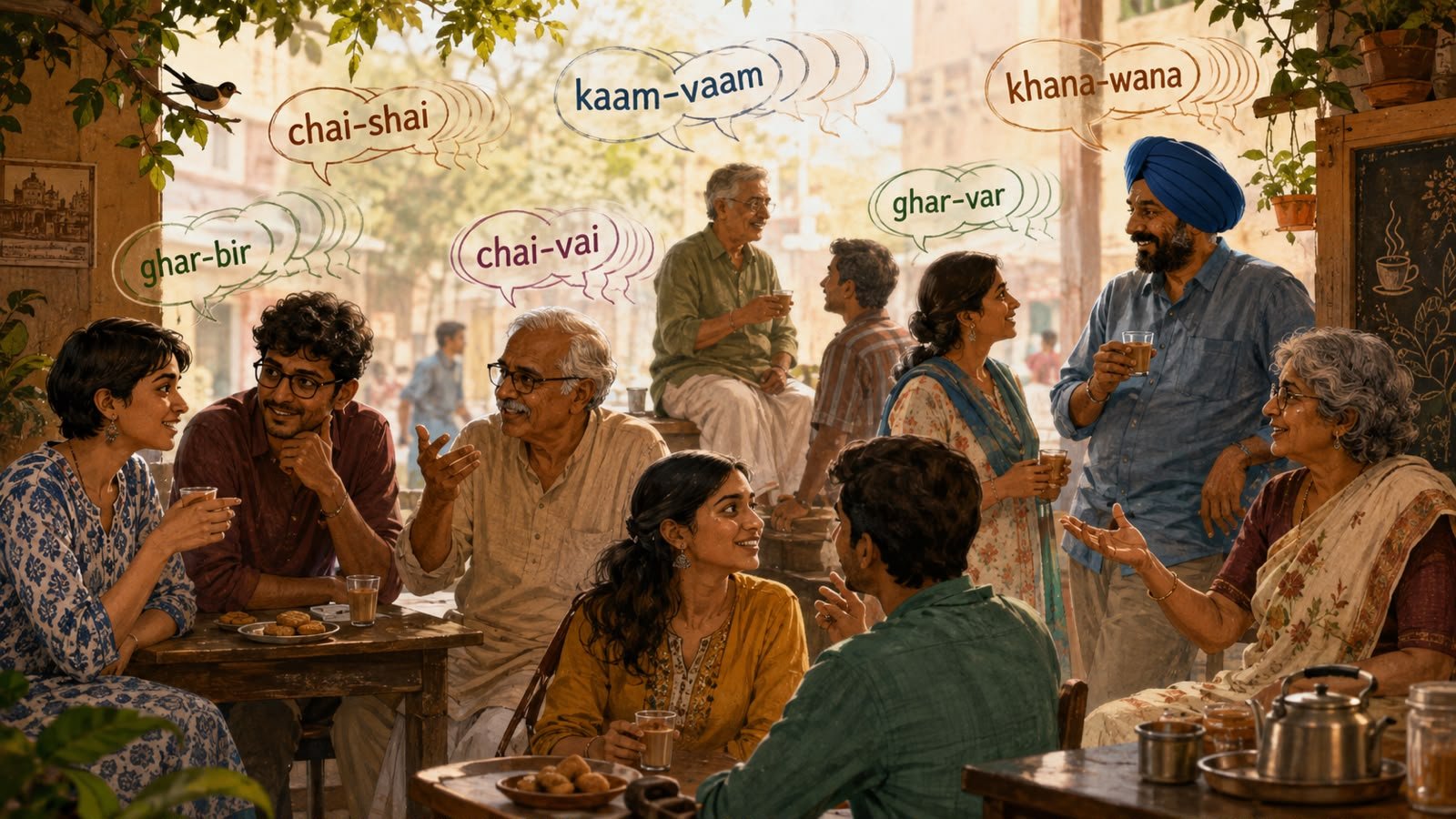
There is chai–vai, kaam–vaam, khana–wana, kapde–wapde, ghar–var.
The second word may have little or no independent meaning. Yet everyone understands what is being conveyed.
“Chai-vai lenge?”
This is not really a question about tea.
It means: “Shall we have some tea or something along those lines?”
“Ghar-var sab theek?”
It means: “Is everything all right at home and elsewhere?”
The beauty lies precisely in the vagueness.
It releases the speaker from the burden of precision.
English, especially formal English, is rather unforgiving about such things. But spoken English can be quite another matter.
One of the reasons I enjoy watching Irish and Scottish television series is the extraordinary richness of their colloquial language. I enjoy the way a character can dismiss something as bollocks, describe a miserable situation as shite, or express exasperation with a vocabulary that would make a formal English teacher reach for a red pen.
It is not merely the words that amuse me. It is the way they are said.
The accent, the rhythm, the understatement, the sudden violence of an apparently ordinary word—all of it conveys something that a polite, grammatically impeccable sentence often cannot.
It made me wonder why we are so quick to condemn slang.
Every language has it.
Every generation invents it.
Every region bends its language in its own way.
Slang is often regarded as the untidy undergrowth of language, something to be removed before respectable speech can grow. But perhaps it is the other way around. Slang is where language is most alive.
Formal language tells us what a word means.
Colloquial language tells us what a word feels like.
That distinction matters.
“Have you eaten?” is a question.
“Khaana-shaana hua?” is concern.
The language deliberately refuses to be exact.
And perhaps that is because relationships themselves are rarely exact.
We have always been a civilisation of proximity. Families, neighbours, colleagues, shopkeepers, railway passengers and complete strangers routinely slip into an easy familiarity that would seem remarkable in many other societies.
Our languages reflect that intimacy.
We don’t merely communicate information. We communicate our relationship with the person to whom we are speaking.
These echoes are never trivial additions but cultural fingerprints—subtle yet unmistakable—revealing not only how someone speaks, but where they come from and how comfortably they inhabit their language.
A hurried, clipped “ghar theek hai?” feels different from the warmer, more enveloping “ghar–var sab theek hai?”—the latter carrying within it not just a question, but a sense of concern that lingers a little longer.
And perhaps that is the real genius of slang and colloquial speech.
It does not obey the rules of language so much as reveal the people who speak it.
Once you begin listening, accents become geographies, slang becomes sociology, and a seemingly meaningless little word after another word can become a tiny window into how a language is actually spoken.
I have given only a few examples. Readers may like to share their own observations—and examples from different languages.